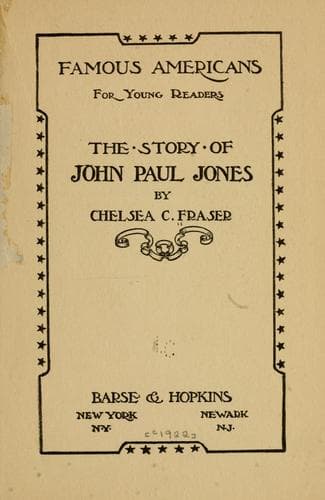
The Story of John Paul JonesFraser, Chelsea Curtis
History
The Story of John Paul Jones
Fraser, Chelsea Curtis
Jones, John Paul, 1747-1792
Bad as were conditions of ship and crew, however, there was one other
feature of the organization which proved a greater handicap to the
Scotch commodore. This was the famous _concordat_, an agreement between
the various commanders of the ships which Paul Jones was compelled to
sign before his commission would be approved by the French minister of
the navy. While its terms related largely to the distribution of prize
money, it also contained clauses which weakened his authority, and gave
his captains a chance to wink at it if they chose.
The little squadron, accompanied by two French privateers, sailed
finally from L'Orient on August 14, 1779, on what was planned to be a
fifty-days' cruise. Thanks to the Duchesse De Chartres's gift of ten
thousand louis d'or, Paul Jones had been able to fit out his flag-ship
in a much better condition than the king's fund would have permitted.
On the 18th the privateer _Monsieur_, which was not bound by the
_concordat_, took a prize which the captain of that vessel proceeded to
relieve of all valuables and then ordered into port. The commodore
opposed this, and sent the prize to L'Orient. This so angered the
_Monsieur's_ captain that he parted company with the squadron.
But the episode was only the beginning of Paul Jones's troubles with
insubordination of officers. While attempting to capture a brigantine,
some of his English sailors deserted in two of his small boats. These
could not be overhauled, and Landais insolently upbraided the commodore
for their loss, declaring that thereafter he would act entirely upon his
own responsibility (which indeed he had been doing right along!). The
_Cerf_ and the other privateer then pretended to go off to look for the
escaped former English prisoners, and they too failed to appear again.
Paul Jones was now left with only the _Bon Homme Richard_, the _Pallas_,
the _Vengeance_, and the _Alliance_. It would have been better, as later
events showed, if the latter ship had decamped with the _Cerf_ and the
privateers; for Captain Landais impudently ignored all of Paul Jones's
signals. He even had the audacity to leave the squadron for several days
at a time, as the cruise continued, returning when the whim seized him.
When other prizes were taken he was bold enough to send two of these
into Bergen, Norway, where they were sold to the English, a procedure
entirely against the wishes of the commodore, and one which was a source
of trouble between Denmark and the United States for many years after
the war.
Paul Jones was also compelled to humor the other French captains.
Several times he changed his course or modified his operations in
compliance with their demands. Had he enjoyed an absolute command he
would have carried out his pet scheme of laying Leith and Edinburgh
under contribution, but he was so afraid that such a venture would
miscarry, owing to the uncertain behavior of his men, that he gave it
up.
Public-domain text, read in full here on John Shaqi.
Reviews
Reviews
No reviews yet
Be the first to share your thoughts on this work.
Elsewhere in the archive
Join the Discussion
Join the discussion
Sign in to leave a comment or review.
Sign InorCreate an account