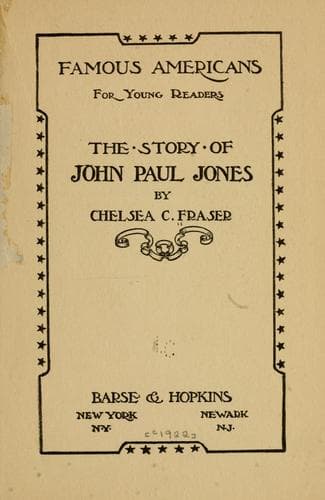
The Story of John Paul JonesFraser, Chelsea Curtis
History
The Story of John Paul Jones
Fraser, Chelsea Curtis
Jones, John Paul, 1747-1792
An important problem now to be solved was how to induce the Dutch
authorities to allow Paul Jones and his battered ships to remain long
enough in a neutral port to make necessary repairs to carry them to
France. Indeed, Sir Joseph Yorke, British minister in Holland, lost no
time in demanding that the Dutch government turn over to England "the
pirate and criminal, Paul Jones, and every ship under his command." An
enormous amount of correspondence then passed between the diplomats of
the three countries concerned; conferences were held; even Paul Jones
himself took a most active hand in presenting his arguments in favor of
the step he had taken. The people of Holland were secretly in sympathy
with the revolting colonies; but the wealthy Dutch ship-owners were
gaining a rich harvest from the commerce with England at this time, and
they made their weighty power felt in settling the question. These men
thought the ships should be held by Holland until after the war.
However, the other contingent argued them down, and the States-General
at last sent England the verdict of his country, which was to the effect
that Holland would _not_ deliver over the vessels to England, but would
insist that they depart from Holland waters at the first favorable
weather.
In the meantime, kind-hearted Dutch maids thronged the decks of the
_Serapis_, _Alliance_, _Pallas_ and _Scarborough_. They brought with
them gifts of food and clothing for the strong and healthy, as well as
an abundance of delicacies for the sick and wounded. More than one
rosy-cheeked, fair-haired girl acted as nurse, and it is no wonder that
under such jolly, tender care the ailing ones made rapid improvement.
As he watched his ships nearing the finish of their repairs, Paul
Jones's heart became more anxious, and often he looked seaward where the
British ships were grimly patrolling to prevent his escape when the
Dutch authorities should order him out at the first favorable wind. He
hoped intensely that this sort of wind would not come before he had
everything aboard in readiness and his plans for evading the enemy well
formed.
On the 13th of December the French minister of marine, De Sartine,
demanded that he should fly the French flag, which naturally commanded
greater respect from Holland than the American ensign. In vain he
expostulated to this gentleman and to Dr. Franklin, his friend in Paris;
the latter stated he thought it the best thing to do. Therefore, Paul
Jones made the change, but with great reluctance. It grieved him deeply
to see the flag of another country, other than that under which the
_Serapis_ had had to bow down to, fluttering at her masthead.
Public-domain text, read in full here on John Shaqi.
Reviews
Reviews
No reviews yet
Be the first to share your thoughts on this work.
Elsewhere in the archive
Join the Discussion
Join the discussion
Sign in to leave a comment or review.
Sign InorCreate an account