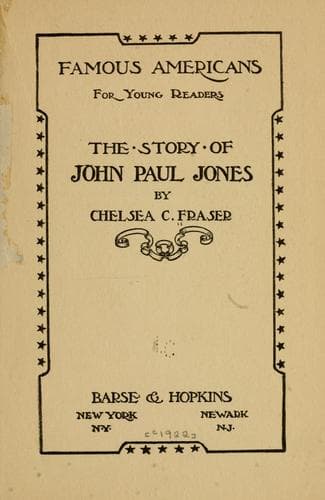
The Story of John Paul JonesFraser, Chelsea Curtis
History
The Story of John Paul Jones
Fraser, Chelsea Curtis
Jones, John Paul, 1747-1792
Close upon the heels of this disappointment came another to tear the
heartstrings of the irritated Scotchman. This was an order for him to
relinquish supervision of all his ships except the _Alliance_, which he
was to command as an ordinary captain. The _Serapis_ he must turn over
to Captain Cottineau, who, it was said, would look after the fortunes of
this vessel, as well as the _Pallas_ and the _Vengeance_ and the
_Scarborough_, in the future. Commodore Jones sent vehement
protestations at this humiliating change to the French government and
the American commissioners, but in vain; no other arrangement could well
be made, wrote Dr. Franklin. So our hero bowed in submission, although
when he went aboard the _Alliance_ as her captain he defiantly pulled
down the French flag at her peak and ran up the Stars-and-Stripes.
The incessant jangling and wrangling with the diplomats of three
countries in addition to his own, had made Paul Jones very sore at
heart. Therefore, he was very glad when, on Christmas Day, 1779, the
weather underwent a change which promised him a chance to get away from
The Texel. That morning he awoke to find such a gale blowing that most
of the patrolling English frigates were driven off the coast. All that
day and the next it howled so furiously that he dared not venture to
steal out himself; but early on the morning of the 27th he made a dash
in the _Alliance_, boldly shaping his course for the Straits of Dover.
As daring as ever, he sailed down the English Channel, passing close to
the Channel Fleet of the enemy. They gave chase, but he outmaneuvred
them, and finally put in at Corunna, Spain, for repairs. On February 10,
1780, he sailed into L'Orient.
The following year was passed mainly in France, where Paul Jones applied
himself energetically to trying to collect prize money for his men and
himself, and trying to secure an important command. He wrote rather more
than his usual large number of letters,--to Franklin, the Duchesse De
Chartres, Robert Morris, Arthur Lee, Dr. Bancroft, and many others,--in
an endeavor to carry out some of his pet plans for the betterment of war
operations. In spite of his hard efforts to collect this prize money,
there were many annoying delays caused by technicalities, and his crew
as a whole grew impatient and rebellious. This feeling was increased
when the traitor, Landais, suddenly appeared among them, and abetted by
Arthur Lee, stirred up the men with many lies.
Public-domain text, read in full here on John Shaqi.
Reviews
Reviews
No reviews yet
Be the first to share your thoughts on this work.
Elsewhere in the archive
Join the Discussion
Join the discussion
Sign in to leave a comment or review.
Sign InorCreate an account