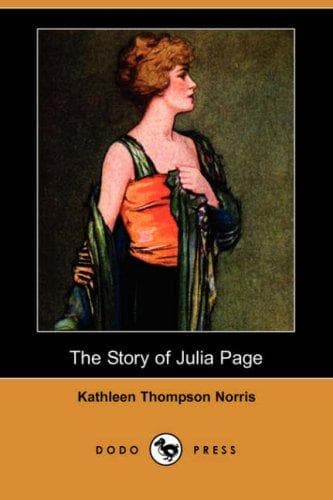
Marriage -- Fiction; Runaway husbands -- Fiction; Social settlements -- Fiction; Women -- Fiction
Once a month there was a dance for the older girls, to which their
"friends," a word which meant to each girl her foremost male admirer,
were asked, and at which cake and ice-cream were served. Julia always
wore her uniform to these dances, but she also danced, when asked, and
never attempted to deny that she enjoyed herself. But that there was an
immense gulf already widening between her and these other girls, one of
whom she might have been, she soon began to perceive. They were noisy,
ignorant, coarse young creatures, like children unable to see beyond the
pleasure or the discomfort of the day, unable to help themselves out of
the sordid rut in which they had been born. Julia watched them soberly,
silently, as the years went by. One by one they told her of their
wedding plans, and introduced the boyish, ill-shaven, grinning lads who
were to be husbands and fathers soon. One by one Julia watched the
pitifully gay little weddings, in rooms poisonous with foul air and
crowded with noisy kinspeople. One by one she welcomed old members of
the Girls' Club as new members of the Mothers' Club. The young mother's
figure would be curiously shapeless now, her girlish beauty swept away
as by a sponge, her nervous pride in the beribboned baby weakened by her
own physical weakness and clouded by the fear that already a second
child's claim was disputing that of the first. And already her young
voice would borrow some of the hopeless whining tones of the older
women's.
Julia was really happiest in her relationship with the children. She
frequently peeped into the kindergarten during the morning, and had her
dearly loved favourites among the tiny girls and boys, and she could
never be absent from the sewing class every afternoon when some forty
small girls scattered themselves about the assembly hall, and chattered
and sang as they worked. Volunteers from among the city's best families
were usually on hand to inspect the actual sewing--vague, daintily
dressed girls who alternately spoiled and neglected their classes, who
came late and left early--but Julia kept order, supplied materials,
recited the closing prayer, and played the marches by which the children
marched out at five o'clock. Now and then she incited some small girl to
sing or recite for the others, and two or three times a year the sewing
classes gave an evening entertainment--extraordinary affairs at the
memory of which Julia and Miss Toland used to laugh for weeks. To drill
the little, indifferent, stupid youngsters in songs and dances, to
spangle fifty costumes of paper cambric and tissue, to shout emphatic
directions about the excited murmurings of the churning performers, to
chalk marks on the stage, and mark piano scores, were all duties that
fell to the two resident workers. Julia sacrificed her immaculate
bedroom for a green room, the perspiration would stream from her face as
she whipped off one dirty little frock after another, fastened the fairy
Public-domain text, read in full here on John Shaqi.
Reviews
Reviews
No reviews yet
Be the first to share your thoughts on this work.
Elsewhere in the archive
Join the Discussion
Join the discussion
Sign in to leave a comment or review.
Sign InorCreate an account