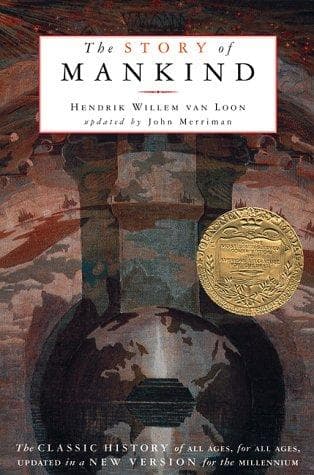
World history; World history -- Juvenile literature
Then came the Dark Ages. The barbarian was the proverbial bull in
the china-shop of western Europe. He had no use for what he did not
understand. Speaking in terms of the year 1921, he liked the magazine
covers of pretty ladies, but threw the Rembrandt etchings which he had
inherited into the ash-can. Soon he came to learn better. Then he tried
to undo the damage which he had created a few years before. But the
ash-cans were gone and so were the pictures.
But by this time, his own art, which he had brought with him from the
east, had developed into something very beautiful and he made up for
his past neglect and indifference by the so-called “art of the Middle
Ages” which as far as northern Europe is concerned was a product of
the Germanic mind and had borrowed but little from the Greeks and the
Latins and nothing at all from the older forms of art of Egypt and
Assyria, not to speak of India and China, which simply did not exist,
as far as the people of that time were concerned. Indeed, so little had
the northern races been influenced by their southern neighbours that
their own architectural products were completely misunderstood by the
people of Italy and were treated by them with downright and unmitigated
contempt.
You have all heard the word Gothic. You probably associate it with the
picture of a lovely old cathedral, lifting its slender spires towards
high heaven. But what does the word really mean?
It means something “uncouth” and “barbaric”—something which one might
expect from an “uncivilised Goth,” a rough backwoods-man who had no
respect for the established rules of classical art and who built his
“modern horrors” to please his own low tastes without a decent regard
for the examples of the Forum and the Acropolis.
And yet for several centuries this form of Gothic architecture was the
highest expression of the sincere feeling for art which inspired the
whole northern continent. From a previous chapter, you will remember
how the people of the late Middle Ages lived. Unless they were peasants
and dwelt in villages, they were citizens of a “city” or “civitas,” the
old Latin name for a tribe. And indeed, behind their high walls and
their deep moats, these good burghers were true tribesmen who shared
the common dangers and enjoyed the common safety and prosperity which
they derived from their system of mutual protection.
Public-domain text, read in full here on John Shaqi.
Reviews
Reviews
No reviews yet
Be the first to share your thoughts on this work.
Elsewhere in the archive
Join the Discussion
Join the discussion
Sign in to leave a comment or review.
Sign InorCreate an account