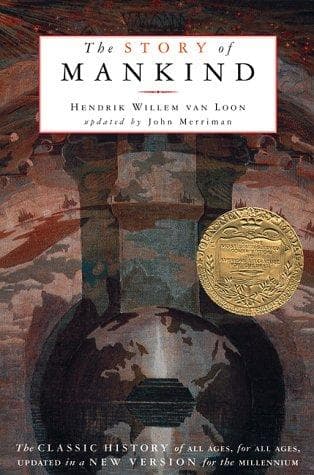
World history; World history -- Juvenile literature
When we visit a doctor, we find out before hand whether he is a surgeon
or a diagnostician or a homeopath or a faith healer, for we want to
know from what angle he will look at our complaint. We ought to be as
careful in the choice of our historians as we are in the selection of
our physicians. We think, “Oh well, history is history,” and let it go
at that. But the writer who was educated in a strictly Presbyterian
household somewhere in the backwoods of Scotland will look differently
upon every question of human relationships from his neighbour who as a
child, was dragged to listen to the brilliant exhortations of Robert
Ingersoll, the enemy of all revealed Devils. In due course of time,
both men may forget their early training and never again visit either
church or lecture hall. But the influence of these impressionable years
stays with them and they cannot escape showing it in whatever they
write or say or do.
In the preface to this book, I told you that I should not be an
infallible guide and now that we have almost reached the end, I
repeat the warning. I was born and educated in an atmosphere of
the old-fashioned liberalism which had followed the discoveries of
Darwin and the other pioneers of the nineteenth century. As a child,
I happened to spend most of my waking hours with an uncle who was a
great collector of the books written by Montaigne, the great French
essayist of the sixteenth century. Because I was born in Rotterdam and
educated in the city of Gouda, I ran continually across Erasmus and
for some unknown reason this great exponent of tolerance took hold of
my intolerant self. Later I discovered Anatole France and my first
experience with the English language came about through an accidental
encounter with Thackeray’s “Henry Esmond,” a story which made more
impression upon me than any other book in the English language.
If I had been born in a pleasant middle western city I probably
should have a certain affection for the hymns which I had heard in
my childhood. But my earliest recollection of music goes back to the
afternoon when my Mother took me to hear nothing less than a Bach
fugue. And the mathematical perfection of the great Protestant master
influenced me to such an extent that I cannot hear the usual hymns of
our prayer-meetings without a feeling of intense agony and direct pain.
Again, if I had been born in Italy and had been warmed by the sunshine
of the happy valley of the Arno, I might love many colourful and
sunny pictures which now leave me indifferent because I got my first
artistic impressions in a country where the rare sun beats down upon
the rain-soaked land with almost cruel brutality and throws everything
into violent contrasts of dark and light.
Public-domain text, read in full here on John Shaqi.
Reviews
Reviews
No reviews yet
Be the first to share your thoughts on this work.
Elsewhere in the archive
Join the Discussion
Join the discussion
Sign in to leave a comment or review.
Sign InorCreate an account