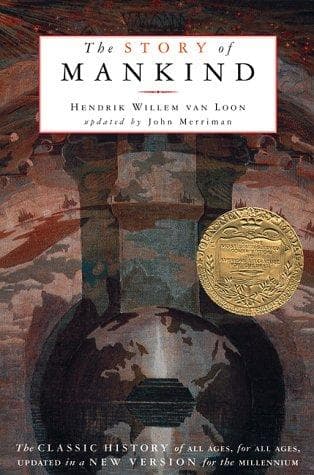
World history; World history -- Juvenile literature
I state these few facts deliberately that you may know the personal bias
of the man who wrote this history and may understand his point-of-view.
The bibliography at the end of this book, which represents all sorts
of opinions and views, will allow you to compare my ideas with those of
other people. And in this way, you will be able to reach your own final
conclusions with a greater degree of fairness than would otherwise be
possible.
After this short but necessary excursion, we return to the history of
the last fifty years. Many things happened during this period but very
little occurred which at the time seemed to be of paramount importance.
The majority of the greater powers ceased to be mere political agencies
and became large business enterprises. They built railroads. They
founded and subsidized steam-ship lines to all parts of the world. They
connected their different possessions with telegraph wires. And they
steadily increased their holdings in other continents. Every available
bit of African or Asiatic territory was claimed by one of the rival
powers. France became a colonial nation with interests in Algiers and
Madagascar and Annam and Tonkin (in eastern Asia). Germany claimed parts
of southwest and east Africa, built settlements in Kameroon on the
west coast of Africa and in New Guinea and many of the islands of the
Pacific, and used the murder of a few missionaries as a welcome excuse
to take the harbour of Kisochau on the Yellow Sea in China. Italy tried
her luck in Abyssinia, was disastrously defeated by the soldiers of
the Negus, and consoled herself by occupying the Turkish possessions in
Tripoli in northern Africa. Russia, having occupied all of Siberia, took
Port Arthur away from China. Japan, having defeated China in the war of
1895, occupied the island of Formosa and in the year 1905 began to
lay claim to the entire empire of Corea. In the year 1883 England, the
largest colonial empire the world has ever seen, undertook to "protect"
Egypt. She performed this task most efficiently and to the great
material benefit of that much neglected country, which ever since the
opening of the Suez canal in 1868 had been threatened with a foreign
invasion. During the next thirty years she fought a number of colonial
wars in different parts of the world and in 1902 (after three years of
bitter fighting) she conquered the independent Boer republics of the
Transvaal and the Orange Free State. Meanwhile she had encouraged Cecil
Rhodes to lay the foundations for a great African state, which reached
from the Cape almost to the mouth of the Nile, and had faithfully picked
up such islands or provinces as had been left without a European owner.
Public-domain text, read in full here on John Shaqi.
Reviews
Reviews
No reviews yet
Be the first to share your thoughts on this work.
Elsewhere in the archive
Join the Discussion
Join the discussion
Sign in to leave a comment or review.
Sign InorCreate an account