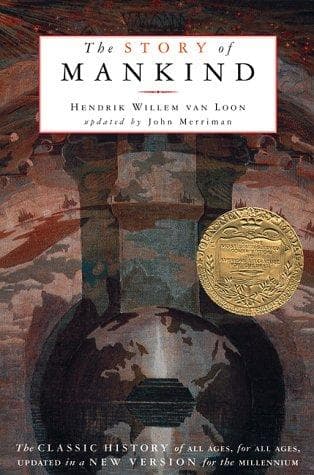
World history; World history -- Juvenile literature
Neither the publishers nor the author claim that "The Story of Mankind"
is the last word to be said upon the subject of history for children. It
is an appetizer. The book tries to present the subject in such a fashion
that the average child shall get a taste for History and shall ask for
more.
To facilitate the work of both parents and teachers, the publishers have
asked Miss Leonore St. John Power (who knows more upon this particular
subject than any one else they could discover) to compile a list of
readable and instructive books.
The list was made and was duly printed.
The parents who live near our big cities will experience no difficulty
in ordering these volumes from their booksellers. Those who for the
sake of fresh air and quiet, dwell in more remote spots, may not find it
convenient to go to a book-store. In that case, Boni and Liveright will
be happy to act as middle-man and obtain the books that are desired.
They want it to be distinctly understood that they have not gone into
the retail book business, but they are quite willing to do their share
towards a better and more general historical education, and all orders
will receive their immediate attention.
AN HISTORICAL READING LIST FOR CHILDREN
"Don't stop (I say) to explain that Hebe was (for once) the legitimate
daughter of Zeus and, as such, had the privilege to draw wine for the
Gods. Don't even stop, just yet, to explain who the Gods were. Don't
discourse on amber, otherwise ambergris; don't explain that 'gris'
in this connection doesn't mean 'grease'; don't trace it through
the Arabic into Noah's Ark; don't prove its electrical properties
by tearing up paper into little bits and attracting them with
the mouth-piece of your pipe rubbed on your sleeve. Don't insist
philologically that when every shepherd 'tells his tale' he is not
relating an anecdote but simply keeping 'tally' of his flock. Just go
on reading, as well as you can, and be sure that when the children get
the thrill of the story, for which you wait, they will be asking more
questions, and pertinent ones, than you are able to answer."--("On the
Art of Reading for Children," by Sir Arthur Quiller-Couch.)
The Days Before History
"How the Present Came From the Past," by Margaret E. Wells, Volume I.
How earliest man learned to make tools and build homes, and the
stories he told about the fire-makers, the sun and the frost. A simple,
illustrated account of these things for children. "The Story of Ab," by
Stanley Waterloo.
A romantic tale of the time of the cave-man. (A much simplified edition
of this for little children is "Ab, the Cave Man" adapted by William
Lewis Nida.) "Industrial and Social History Series," by Katharine E.
Dopp.
"The Tree Dwellers--The Age of Fear"
"The Early Cave-Men--The Age of Combat"
"The Later Cave-Men--The Age of the Chase"
"The Early Sea People--First Steps in the Conquest of the Waters"
"The Tent-Dwellers--The Early Fishing Men"
Public-domain text, read in full here on John Shaqi.
Reviews
Reviews
No reviews yet
Be the first to share your thoughts on this work.
Elsewhere in the archive