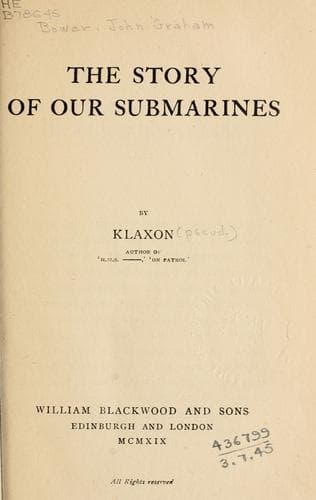
World War, 1914-1918 -- Naval operations -- Submarine
The gauge-needle went round with a rush; there was a heavy shock, and
the boat's bow sprang upwards (the captain, holding with one arm to the
periscope and bracing his feet, had a momentary vision in his memory of
a photograph of a tank climbing a parapet--a trivial recollection of a
Bond Street shop window); she rolled to starboard as the gauge-needle
jumped back from a hundred and twenty to the hundred mark, then bounced
again as her tail touched, rolled to port, and slid along the bottom
to rest on an even keel. _Whang-bang-whang._ The explosions of
depth-charges passed overhead and made the lights flicker; then a
succession of fainter reports continuing to the southward told of a
chase misled in the mist. A voice spoke from a tube at the captain's
side, "Did they hit, sir?"
The captain was feeling vaguely in his pockets. A reaction from the
tense concentration of the last few minutes was approaching, and the
habits of an habitual smoker were calling to him. "Yes, I think so," he
said; "but there were so many explosions I can't swear to it. We'll
know when we get in."
He took a cigarette from his case and lit it. The match burnt blue and
went out quickly; the cigarette gave him a mouthful of acrid smoke, and
also failed. The short time the conning-tower had been open before the
destroyers came had not cleared the air, and the work and excitement of
the crew in the attack had consumed as much oxygen as if the boat had
been diving for a summer's day. There is only one kind of cigarette
which will burn in bad air; a stoker kneeling by the main line
flooding-valve fumbled in his cap, and then held out a packet of five
of them to the captain. The officer took one with a grunt of thanks,
lit it, and spoke again. "Watch remain at diving-stations--fall out the
rest--torpedo hands reload."
III
I am just branching off to the Adriatic a moment to describe a patrol
trip by "E 21" (Lieutenant Carlyon Britton). In this account of British
submarine doings I have been avoiding such incidents as have been
already much better treated of by writers such as Rudyard Kipling and
Sir Henry Newbolt. There are, however, a good many incidents for which
they had not space in their accounts, and mention of such incidents
here will lay stress on the fact that submarine work was continuous
throughout the war, and was not a matter of spasmodic effort.
Public-domain text, read in full here on John Shaqi.
Reviews
Reviews
No reviews yet
Be the first to share your thoughts on this work.
Elsewhere in the archive
Join the Discussion
Join the discussion
Sign in to leave a comment or review.
Sign InorCreate an account