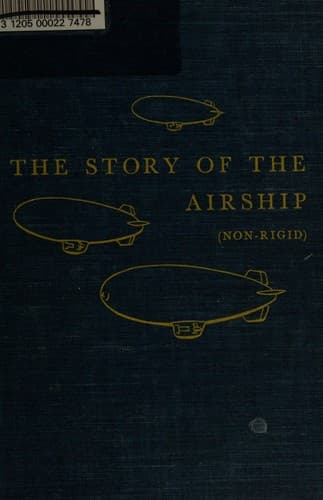
The Story of the Airship (Non-rigid): A Study of One of America's Lesser Known Defense WeaponsAllen, Hugh
History
The Story of the Airship (Non-rigid): A Study of One of America's Lesser Known Defense Weapons
Allen, Hugh
Military airships -- United States
Stacy, another New Englander, left the class room at Massachusetts Tech
to sign up. Dixon, born in a lighthouse on Nantucket Island, left a
billet as junior officer on a South American liner to fly land ships
instead. Trotter, from the Naval Academy, was in engineering work in
Florida when a blimp flew over. Lueders came in via the ground crew at
Los Angeles.
Many of the Goodyear pilots were commissioned as Reserve officers in the
Navy, and Fickes, Boettner, Lange, Sewell, Wilson, Trotter and Furculow
each took a year’s active duty with the Navy at Lakehurst with rigid
ships. More than a score of trips were made by Goodyear pilots across
the ocean as student officers aboard the Graf Zeppelin and the
Hindenburg, getting post-graduate training.
The breaking up of the pilot organization began as early as 1940, when
with war clouds appearing in the East, Trotter, Rieker and Furculow
volunteered for active duty with the Navy. By the middle of 1941, Stacy,
Smith, Lueders and Dixon had followed them into uniform, were flying
Navy airships at Lakehurst.
To fill their places and also furnish material for the already expanding
airship Navy, a training class of 19 men was started in late 1940 at
Akron and Los Angeles. A six-months’ ground school preceded flight
training—which started with seven balloon flights.
The training course evolved there was one which grew naturally out of
such a situation. Airship piloting had changed from the “seat of the
pants” flying of the first war, when veteran Jack Boettner would turn
out pilots in six weeks. The ships had become more complex as
improvements were made. Helium gas was being used. Navigation by radio
and compass was quite different from the “concrete compass flying” of
1916, when pilots followed highways or railroad tracks to keep on
course. Instrument flying had come in, and blind flying was part of
every student’s training, in a closed control car, operating by
instrument only. The modern airship pilot had to know his radio beams
and the rules of Civil Aeronautics Authority, be able to ride the beam
into the airport. In these various details the Goodyear pilots,
long-seasoned, had perfected themselves through years of operation, were
competent to pass on their secrets to the youngsters coming in.
Public-domain text, read in full here on John Shaqi.
Reviews
Reviews
No reviews yet
Be the first to share your thoughts on this work.
Join the Discussion
Join the discussion
Sign in to leave a comment or review.
Sign InorCreate an account