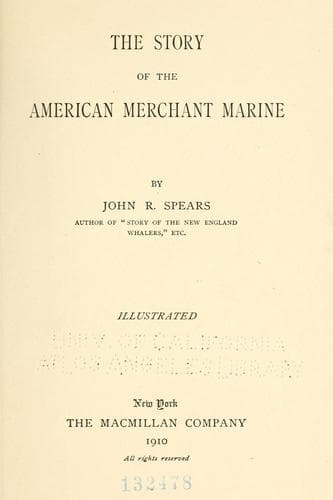
The Story of the American Merchant MarineSpears, John Randolph
History
The Story of the American Merchant Marine
Spears, John Randolph
Merchant marine -- United States
When seen in its true light, one of the most curious and interesting
chapters in the history of the American merchant marine is that relating
to the men who, having the might, used it to take from those who were
weaker not only property but liberty and life; but the reader who supposes
that superior ability, natural or acquired, gives him the _right_ to take
more of the good things of life than his less-favored neighbor receives,
will scarcely comprehend the facts.
The fighting done by the American merchantmen who were commissioned as
privateers during the War of 1812 has been well described by our histories
of the navy, but the story of one battle is worth recalling briefly
because it may well stand in some respects for the story of the entire
fleet. On March 26, 1815, the privateer schooner _General Armstrong_,
Captain Samuel Chester Reid, anchored in Fayal Roads, in the Azores.
As night came on, a British squadron, bound for New Orleans, came into
the roads, and on seeing the _Armstrong_, sent four boats full of men
to capture her. A well-directed broadside from the privateer sent them
in haste back to their ships, but a little after midnight the enemy
came again in twelve boats, carrying more than 400 men. Each boat was
armed with a cannon. The _Armstrong_ had 90 men, and she mounted a long
24-pounder on a pivot with four 9-pounders in each broadside.
When the flotilla came within point-blank range, Captain Reid opened a
fire that would have beaten back any other civilized enemy, but this
veteran host pulled steadily in until the boats were alongside from
stem to stern, and then they rose up, as one man, and strove to board
the low-lying schooner. But with sword and pike and battle-axe the
privateersmen fought not only for life but to avenge the wrongs that had
been suffered by American seamen at the hands of press-gangs, and even
British valor could not face them. One of the defeated wrote that the
"Americans fought more like blood-thirsty savages than anything else."
We may believe that they were thrilled with the joy of battle, and if
a modern, peace-loving American is ever permitted to envy any of his
countrymen who have had part in any battle described in the histories of
the nation, the men of the _General Armstrong_ will come to his mind first
of all. But a liner, a frigate, and a brig were at hand to back the boats,
and at last Reid had to burn his ship.
Public-domain text, read in full here on John Shaqi.
Reviews
Reviews
No reviews yet
Be the first to share your thoughts on this work.
Elsewhere in the archive
Join the Discussion
Join the discussion
Sign in to leave a comment or review.
Sign InorCreate an account