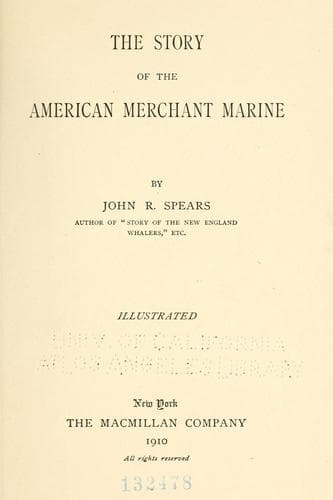
The Story of the American Merchant MarineSpears, John Randolph
History
The Story of the American Merchant Marine
Spears, John Randolph
Merchant marine -- United States
As this legislation had been provided for in the Constitution of the
nation, the trade in slaves was naturally brisk in the years immediately
preceding prohibition. Thus, from January 1, 1804, to December 31,
1807, 202 ships imported 39,075 slaves into the port of Charleston,
South Carolina. Of these ships, 61 were registered at Charleston (though
generally owned elsewhere), 59 were owned in Rhode Island, from 1 to 4
in each of several other American ports, and 70 in England. While the
prospect of prohibition increased the importations at this time beyond
the normal, it is evident that a strong demand for slaves existed among
slave-owners. The demand was particularly strong in the Mississippi
Valley, where the profits on cotton were enormous. This demand naturally
raised the price as soon as lawful importations came to an end. At
the same time the existence of the American prohibitory law (England
prohibited the trade at about the same time, too) depressed the price on
the coast of Africa. Thus a premium was placed on smuggling, and 202 ships
were afloat that had been engaged in the trade to one port alone.
All this is to say that while the law drove many ships out of the trade,
it added much to the profits of those that remained in it.
Because the trade was continued, an effort was made to strengthen the law
in 1818 by increasing the emoluments of informers. Then, by the Act of
March 3, 1819, Congress authorized the President to use the naval ships to
intercept slavers, and finally by the Act of May 15, 1820, all Americans
engaging in the trade were declared pirates, who should be hanged on
conviction.
One would be glad to believe that these laws were enacted because the
American people had become sufficiently enlightened to appreciate the
effects of the trade upon the human race, and especially upon the white
people connected with it, but it is impossible to do so. The laws were
enacted because of a passing wave of sentiment that had its origin in
the work of the pirates herein described. In a dim way people saw that a
connection existed between some of the pirates and the slave-trade. The
slave-trade was held responsible (properly, too) for some of the horrors
of the piracies, and while Congress was legislating against the pirates,
it was easy to get acts against the trade passed. Moreover, the desire of
the slave-owners to rid their States of free negroes was just then giving
strength to the movement for sending those negroes to Africa--Liberia. In
short, the prohibitory laws were the result of a sort of hysteria rather
than of any real enlightenment of the American people. In truth, we are
not so enlightened even now as to appreciate our whole duty toward the
inferior race--properly a race of children--we brought from Africa.
Public-domain text, read in full here on John Shaqi.
Reviews
Reviews
No reviews yet
Be the first to share your thoughts on this work.
Elsewhere in the archive
Join the Discussion
Join the discussion
Sign in to leave a comment or review.
Sign InorCreate an account