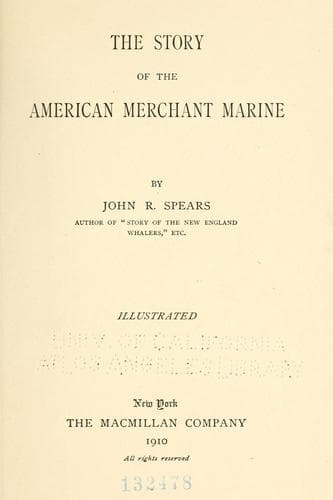
The Story of the American Merchant MarineSpears, John Randolph
History
The Story of the American Merchant Marine
Spears, John Randolph
Merchant marine -- United States
To save a vessel worth at most $5000 from confiscation, Homans murdered
600 negroes. The story is told in detail in the _African Repository_, Vol.
XXIII, p. 371.
The profits in the trade are shown by the fact that slaves costing from
$12 to $20 on the coast of Africa sold for $350, when delivered alive and
able to walk, in Cuba. When smuggled into the United States, they sold
all the way from $750 to $1000.
Old ships of known speed were in demand. Speed was necessary because
the British government maintained cruisers on the coast that captured
and confiscated vessels found with slaves actually on board. Our navy
department sold the schooner _Enterprise_ (the second of the name) to men
in the slave-trade at a small fraction of her value. The swift privateers
of the War of 1812 were also bought for the purpose. In later years it
was the custom to build swift vessels especially for the trade. Baltimore
and New York builders were patronized more than others, New York having
the lead in later years. The builders always knew what trade the vessels
were to enter, and charged accordingly. No builder ever lost standing
in society because he turned out ships for this purpose. In fact, the
slave-traders were well known, and they lived among the wealthiest society
people of New York--at the Astor House, for instance, where they were
in the habit of meeting to arrange the details of their voyages. Public
documents show that the most respected merchants of the city were ready to
go on the bonds of these slavers, when bonds were required. A New Bedford
whale-ship owner who was convicted of fitting out one of his vessels for
the trade was afterward elected mayor of his city. Even after the Civil
War was begun, a United States district attorney--a man appointed by
Lincoln--was seen dining at the leading New York restaurant with a slaver
whom he should have been prosecuting at that moment; for while the two ate
together, the slaver talked about a slave voyage that he intended to make.
Though American packets had for years controlled the trade between the
United States and Europe, and the American clippers were making records
that stirred the whole nautical world, the flag from those proud ships was
used to cover the reeking slime in the slaver's hold, and it was the only
flag that could protect the slaver from inspection on the African coast.
These facts were well known, but they roused not a tremor of indignation
among the American people, not one, save only in the breasts of a few
"fanatics," and the arguments of the fanatics were answered by asking,
"How would you like to have your sister marry a nigger?"
Public-domain text, read in full here on John Shaqi.
Reviews
Reviews
No reviews yet
Be the first to share your thoughts on this work.
Elsewhere in the archive
Join the Discussion
Join the discussion
Sign in to leave a comment or review.
Sign InorCreate an account