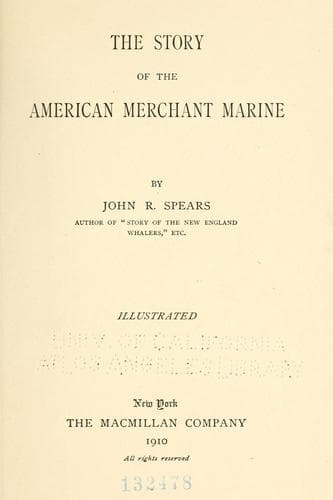
The Story of the American Merchant MarineSpears, John Randolph
History
The Story of the American Merchant Marine
Spears, John Randolph
Merchant marine -- United States
"She was on the rim of a cyclone, most of the time," said the captain in
describing the passage to the writer. The sailors of the day called her
the "Wild Boat of the Atlantic," and some unremembered forecastle bard
wrote a song of nine stanzas about her, of which the first was:--
"It is of a flash packet,
A packet of fame.
She is bound to New York
And the _Dreadnought's_ her name.
She is bound to the west'ard
Where the stormy winds blow.
Bound away in the _Dreadnought_,
To the west'ard we'll go."
Seafaring people are yet alive who well remember the boisterous vigor
with which the old-time sailors used to roar out "Bound away in the
_Dreadnought_, To the west'ard we'll go," wherein all the crew joined the
chanty man.
The counting-house view of the packets must not be overlooked. The
earliest ships cost about $40,000, or say $80 a ton measurement. The later
ones cost nearer $90 a ton, the _Roscius_, of 1100 tons, as noted above,
costing $100,000. The captain usually owned an eighth of his ship, and
many a man of good reputation who lacked the money to buy such a share
was allowed to buy in with a note that was paid off with his share of the
earnings. The captain, who was part owner, naturally handled the ship with
greater economy on that account. The salary of the captain was usually
$360 a year, but in addition he had 5 per cent of the freight money, a
fourth of the cabin passage money, all the money paid for carrying mails
(twopence a letter from the British government, and two cents from the
American), and the privilege of carrying his wife board free. On the
whole, these captains made not far from $5000 a year.
The number of cabin passengers varied from 30 in the earlier days up to
80 in the later, though there were many passages, of course, when the
cabin was nearly empty. The price of passage was $140 during most of the
time, but competition cut it to $100, now and then. The owners, however,
calculated on an income of from $2000 to $5000 per passage from the cabin.
The income from freights ran from $5000 to $10,000 per passage. Each ship
made six passages a year. Much larger sums were earned in a single passage
at times. The _Orient_, Captain George S. Hill, once made a gross income
of $50,000 for a round voyage, while the _Webster_, Captain Joseph J. Law,
made $60,000.
Public-domain text, read in full here on John Shaqi.
Reviews
Reviews
No reviews yet
Be the first to share your thoughts on this work.
Elsewhere in the archive
Join the Discussion
Join the discussion
Sign in to leave a comment or review.
Sign InorCreate an account