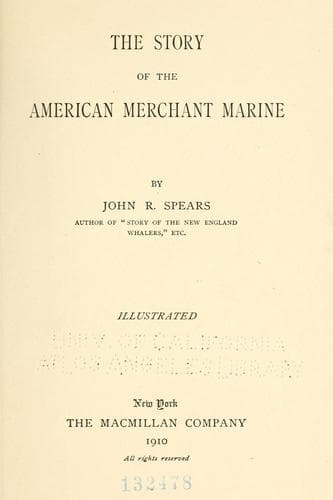
The Story of the American Merchant MarineSpears, John Randolph
History
The Story of the American Merchant Marine
Spears, John Randolph
Merchant marine -- United States
The _Howqua's_ best work was the run from Shanghai to New York in 88 days.
The _Water Witch_, called "the swiftest ship of her day," was commanded
by Captain Robert H. Waterman ("Captain Bob"). She set the pace when she
sailed from New York on December 23, 1846. In 25 days she hove to off Rio
Janeiro long enough to send mail ashore on an inbound ship, and in 104
days she reached Hongkong. Her return run from Canton was made in 81 days.
In the next voyage she returned from Canton in 77 days, her best day's
run being 358 sea miles, something then unheard of.
There were a number of other celebrated clippers in the China trade, but
none of them was swifter than the _Shooting Star_, with a passage record
of 88 days from Canton, and the _Atlanta_ with a record of 84; none
equalled Waterman's passage of 77 days.
When the captains of these clippers, dressed in "lustrous, straw-colored,
raw-silk suits," paraded the water front of New York, they were more
admired and envied by the loungers than any prince or potentate on earth.
They were the kings of the sea by right of conquest. Imagine what Captain
Waterman would have done if told that he reigned by grace of "a system of
national protection deliberately initiated in 1789!"
In 1849 the British government, in a desperate determination to place
British shipping ahead of American in quality as well as quantity,
repealed the old navigation laws. British merchants were not only
permitted to buy American ships, but American ships were permitted to
enter all trades to the United Kingdom. The British ship-builders declared
their business would be ruined; and the building of the old-style wooden
ships was ruined. The ship-owners, too, saw disaster staring them in the
face, and, for a time, there was reason for their fears. For where the
British ships in the tea trade received from £3 to £4 per ton (50 cubic
feet) from Canton to London, the American clippers received six and even
more.
The little Baltimore clipper _Architect_, having made a run from Canton
to London in 107 days, beating the fleet by about a week, she was paid
£8 a ton when next she applied for a cargo of new-crop teas. The ordinary
ships were glad to get the common £4.
In the meantime the California territory was acquired from Mexico by the
treaty proclaimed July 4, 1848. Placer gold had already been discovered
in El Dorado county (January 24), and when official reports confirmed the
wide-spread rumors of the "find," a migration of gold-seekers such as the
world had never seen was begun.
The growth of population in the territory was phenomenal, and the growth
at once created an insistent demand for many products of civilization,
especially for such things as were needed by miners and town-builders; for
the whole region was a wilderness. This demand was backed by gold washed
from the placers, and the prices seem now almost beyond belief.
Public-domain text, read in full here on John Shaqi.
Reviews
Reviews
No reviews yet
Be the first to share your thoughts on this work.
Elsewhere in the archive
Join the Discussion
Join the discussion
Sign in to leave a comment or review.
Sign InorCreate an account