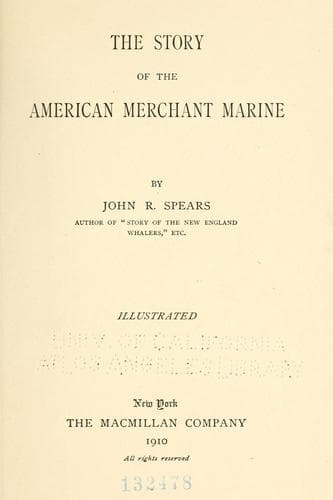
The Story of the American Merchant MarineSpears, John Randolph
History
The Story of the American Merchant Marine
Spears, John Randolph
Merchant marine -- United States
This is not to deny that the clippers were in some respects grand ships.
They were superior in the strength of hull, _in the breadth of beam_, and,
consequently, _in the spread of canvas under which they could stand_. In
the _general proportions_ of their hulls many of them were right--as was
the old frigate _Constitution_, which had a bow as round as an apple and
yet had a record of better than 12 knots an hour. But even when all of
that is said, the fact remains that the full-lined _Natchez_ was but a
day behind the record from Canton.
If it was not to the model of the ships, to what, then, were the splendid
records due? The answer is of the utmost importance in any study of the
American merchant marine. The records were due to the fact that our seamen
were the most ambitious and the most efficient sailors _of the sail_ that
the world has ever seen. While the gale permitted the ship to hold her
course, the captain paced the deck the whole night long and caught his
sleep by day in short naps under the weather rail in order that he might
see that she was kept going. The sheets and halyards of the important
sails on those record ships were made of chains, and they were locked
fast in place--held by padlocks, so that frightened sailors, unseen by
the master, could not let them fly when the ship, rolling to the blast at
night, dragged her lee rail through the solid water. When the captain gave
an order, the crew ran with all their might to do the work--or they were
knocked across the deck with a pump-brake in the hands of the nerve-racked
mate. Captain Waterman even shot men off the yards because they seemed to
be handling the sails slowly. Studding sails were spread to the zephyrs
when the ship crossed the equator, and they were yet seen in place while
she sailed with trade-winds so strong that ships from Europe close-hauled
were reefed down to the cap. Indeed, all sail was often carried when
ordinary ships were seen reefed down on the same course. As Clark Russell
notes in one of his novels, the skipper of the ship from Europe, as he
paced the deck with anxious eyes upon his shortened canvas, fearing that
it would be blown from the bolt ropes, very often saw a tiny white speck
upon the horizon, watched it grow into a splendid ship with "every rag
set," saw her fling the Stars and Stripes to the gale, as she went roaring
by, and then with feelings that cannot be described, gazed after her until
she disappeared in the mists far down the lee.
If the two crews thus meeting in mid-ocean could have changed ships, the
bluff-bowed hulk from Europe would soon have gone smoking away while the
clipper would have rolled her spars over the lee rail before her new crew
could have learned the lead of a single sheet or halyard.
Public-domain text, read in full here on John Shaqi.
Reviews
Reviews
No reviews yet
Be the first to share your thoughts on this work.
Elsewhere in the archive
Join the Discussion
Join the discussion
Sign in to leave a comment or review.
Sign InorCreate an account