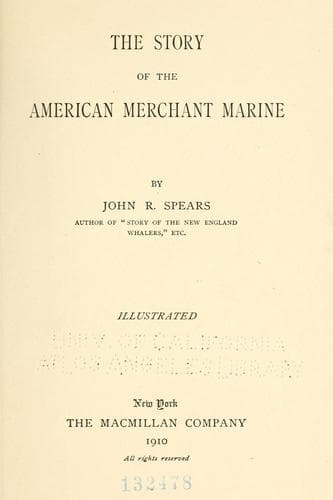
The Story of the American Merchant MarineSpears, John Randolph
History
The Story of the American Merchant Marine
Spears, John Randolph
Merchant marine -- United States
In 1837 the British manner of ruling the Canadian region created so much
opposition among the settlers there that a small insurrection broke out.
It was suppressed, but only to break out again, and at this time a number
of American sympathizers joined the insurgents. A band of the insurgents
having taken possession of Navy Island, in the Niagara River, the American
sympathizers went in the American steamer _Caroline_ to join them, and
carried arms and supplies. The steamer then returned to American waters,
but the British loyalists crossed over the line, captured the steamer,
set her on fire, and sent her over Niagara Falls. One American was killed
in the attack. Later a Canadian deputy sheriff boasted that he had killed
the man whose life was taken, and then, in 1840, incautiously came across
to Lockport, New York, where he was arrested for the murder. His name was
Alexander McLeod. Thereupon the British government, with the aggressive
Palmerston in the lead, avowed that the _Caroline_ was seized on the
authority of the nation, and peremptorily demanded McLeod's release.
The Washington authorities were disposed to yield, but Governor Seward,
of New York, declared that McLeod should stand trial; and he did. But
having proved an alibi, he was acquitted, and on October 12, 1841, he
was returned to Canada. In the meantime an American had been seized as a
hostage to abide McLeod's fate. He was of course released at last.
In the course of the year 1841 an American coaster named the _Creole_,
while carrying a cargo of slaves from the breeding grounds in Virginia
to the ever eager market in the Southwest, was taken from her officers
and crew by the slaves, who then ran the vessels to the Bahamas, where
the slaves, 125 in number, were protected. The slave owners of the United
States had been restive because of frequent reports that British cruisers,
engaged in suppressing the slave trade upon the coast of Africa, had
"exercised the right of search" by boarding ships under the American flag,
and when the story of the protection of the _Creole's_ cargo reached the
country, the excitement rose toward the war heat.
Public-domain text, read in full here on John Shaqi.
Reviews
Reviews
No reviews yet
Be the first to share your thoughts on this work.
Elsewhere in the archive
Join the Discussion
Join the discussion
Sign in to leave a comment or review.
Sign InorCreate an account