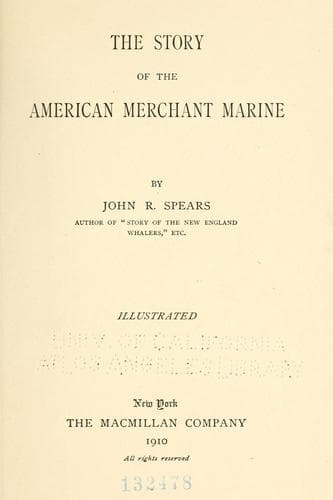
The Story of the American Merchant MarineSpears, John Randolph
History
The Story of the American Merchant Marine
Spears, John Randolph
Merchant marine -- United States
Still another important fact is this, that the American capitalists who
began to invest in steamships at an early day, found immense stretches of
inland waters upon which to develop the carrying trade, while the inland
waters of Great Britain were of insignificant extent, and the capitalists
there were soon engaged in the coasting trade where the waters were by no
means pacific. In 1818 the _Rob Roy_ was put on the route between Glasgow
and Belfast, and a little later she was sent to ply between Dover and
Calais. In 1822 a line was established between Liverpool and Glasgow, and
this was followed in 1826 by a line plying between Edinburgh and London.
These last ships were 160 feet long and were provided with engines of 200
horse-power; they were regarded as such marvellous ships that people came
from all parts of the kingdom to look at them. And it is to be noted that
all the coasters so far mentioned were provided with a form of engine (the
side lever) which was efficient for deep-water service.
Following the success of the Glasgow line, other lines were established
to various ports of Europe, including one to Bordeaux, the ships of which
had to cross the stormy Bay of Biscay and traverse a route 1600 miles
long. All of this is to emphasize the fact that while the steamship men of
the United States were making records upon the Hudson and other _inland_
waters, those of Great Britain were engaged almost exclusively upon waters
with a rending power little, if any, less than that of the Atlantic. The
environments of the men engaged in steamboat traffic in the two countries
were so different that widely different classes of ships, engines, _and
engineers_ were developed. The British had been navigating the Bay of
Biscay with success for several years before the Americans put the _Home_
upon the route around Cape Hatteras.
And yet it was an American that first stirred up the British to embark
in the transatlantic steamer trade--Dr. Junius Smith, who graduated from
Yale in 1802, and then went to London as representative of some American
merchants. The success of the British coasters led Smith to believe that
transatlantic steamers would prove successful, and in 1832 he came to the
United States to look into the matter more fully.
Public-domain text, read in full here on John Shaqi.
Reviews
Reviews
No reviews yet
Be the first to share your thoughts on this work.
Elsewhere in the archive
Join the Discussion
Join the discussion
Sign in to leave a comment or review.
Sign InorCreate an account