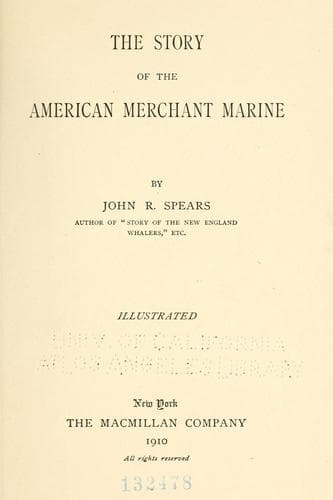
The Story of the American Merchant MarineSpears, John Randolph
History
The Story of the American Merchant Marine
Spears, John Randolph
Merchant marine -- United States
Out of several reasons for this failure, consider these: The American
people had but little capital, and there were calls in many directions for
every dollar obtainable. The calls from the railroads were particularly
insistent, for while the first railroad to use steam (the Albany and
Schenectady) was completed in 1833, the steam mileage in 1840 was 2380.
The inland water traffic was most attractive. In 1839 the enrolled
steamers measured 489,879 tons, and they were worn out so rapidly that
every vessel had to be replaced (on the average) within four years. Then
the deep-water sailing ships absorbed much capital, the tonnage in 1839
being 829,096, while the coasting tonnage measured 1,032,023 tons, and
all these vessels were, on the average, highly profitable.
Of the other attractive calls for capital, nothing need be said, but
a brief reference to an attempt to form a company to run transatlantic
steamships from Philadelphia may be quoted from _Niles's Register_ of
August 25, 1838:--
"At a meeting of the citizens held in the Merchants' Exchange,
Philadelphia, to take such measures to forward the plan for a
communication by steam between that city and Europe ... the following
resolutions were unanimously adopted: ... Resolved that we have learned
with lively satisfaction the willingness of our brethren of Great Britain
to coöperate with us in this great enterprise" by making a liberal
subscription for the construction of "such steamships as might be needed."
The "brethren" were not quite as willing to "coöperate" as was supposed,
but the "great enterprise" was taken in hand a few years later by a man
named William Inman, with notable results.
In considering their failures to organize transatlantic steamship
companies, these business men did not fail to refer to the fact that the
British government was paying subsidies to the Cunard and the Royal Mail
steamship companies. The fact that the Cunard subsidy was a hardship for
the owners of the unsubsidized steamers in the American trade was not
dwelt upon. The people were told that subsidies were given in order to
build up a steam merchant marine. Then Congress was invited to consider
the fact that in subsidizing two lines of steamships Great Britain had
secured eighteen fine ships fit to add to her growing steam naval fleet.
Naval officers were carried on all those ships, and they were not only
learning how to handle steam, but they _were learning to navigate American
waters_--and all this at a period when England and the United States were
on the verge of war.
Public-domain text, read in full here on John Shaqi.
Reviews
Reviews
No reviews yet
Be the first to share your thoughts on this work.
Elsewhere in the archive
Join the Discussion
Join the discussion
Sign in to leave a comment or review.
Sign InorCreate an account