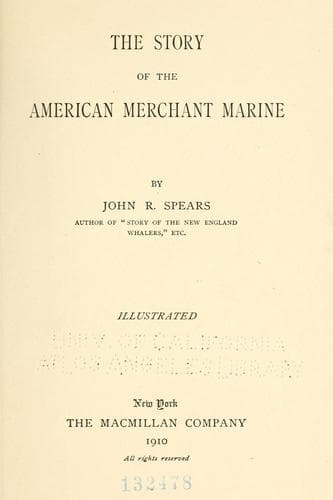
The Story of the American Merchant MarineSpears, John Randolph
History
The Story of the American Merchant Marine
Spears, John Randolph
Merchant marine -- United States
To enable us to comprehend the reasons for the decadence of our merchant
marine it is necessary to have well in mind the fact that we obtained
our supremacy by actual merit. It was an economic development, not the
result of any kind of political or other stimulation. We did not gain or
hold supremacy because we could build ships cheaper than they could be
built elsewhere. Cheaper ships could be had in the north of Europe and in
Canada. Moreover our most profitable ships were those that cost the most
per ton. The American ships were supreme, too, rather because the wages
paid were higher then in spite of that seeming handicap. In short, the
whole environment of the American seafaring population had evolved a ship
and crew which, taken together as a unit, were able to give more ton-miles
for a dollar than any other similar unit in the world.
At first the advent of steamships changed these conditions in but one
respect; it gave greater regularity of passage. The swiftest sailing ships
could cross the Atlantic, now and then, in as short a time as the steamer,
and they carried more cargo at the same time. But the steamer instantly
commanded the cream of the traffic, and received higher rates for it,
because the merchant could calculate, within a day, the time required for
the passage. The time of even the swiftest of sailing ships was sometimes
extended by adverse winds to fifty or sixty days.
This is to say that even the first crude steamships took the best of the
trade because they were more efficient.
With the inevitable improvements in steamships came an encroachment upon
the cheaper traffic that had been carried on sailing ships, and the most
important of these improvements was made when the screw propeller was
adopted.
Stevens had driven a small boat with screws before Fulton built the
_Clermont_, but John Ericsson, a Swede, was the first to develop screw
propulsion in a practical manner. His first work was done in England,
where he built a screw steamer 45 feet long with which he made a speed
(April, 1837) of ten miles an hour on the Thames. Then he towed the
American packet ship _Toronto_ at a speed of four and a half miles
an hour. On July 7, 1838, an iron vessel 70 feet long by 10 wide, and
having a draft of 6 feet 9 inches, named the _Robert F. Stockton_, was
launched at Laird & Co.'s yard, Birkenhead, England, for Captain Robert
F. Stockton, U. S. N. It was fitted with an engine and an Ericsson screw.
It was then brought to America under sail, and set to work under steam as
a tug on the Delaware River, where it earned much money for many years.
In 1839 Ericsson came to the United States and built the screw steamship
_Princeton_ for our navy, the first warship of the kind in commission.
In the meantime Francis P. Smith, an English farmer, was developing screw
propulsion, and succeeded in convincing the Admiralty that the screw was
a practical device, with the result that many experiments were tried and
the screw was much improved.
Public-domain text, read in full here on John Shaqi.
Reviews
Reviews
No reviews yet
Be the first to share your thoughts on this work.
Elsewhere in the archive
Join the Discussion
Join the discussion
Sign in to leave a comment or review.
Sign InorCreate an account