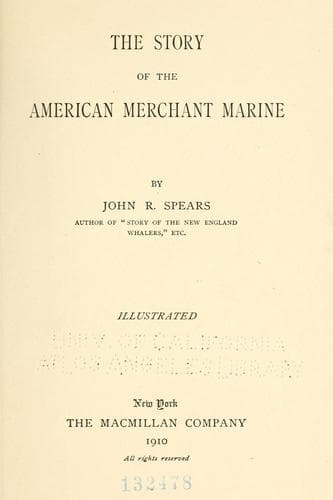
The Story of the American Merchant MarineSpears, John Randolph
History
The Story of the American Merchant Marine
Spears, John Randolph
Merchant marine -- United States
For a number of years the iron screw steamer had small effect upon
the transatlantic trade. The owners of the sailing packets were making
as much money as ever--perhaps more than ever, for they were building
larger ships. In 1850, however, William Inman, an Englishman who had been
interested in sailing ships, put on a line of iron screw packets between
Liverpool and Philadelphia, as noted, and that line sealed the doom of
the sailing packet. For the Collins, the Bremen, and the Cunard lines had
taken, or were to take, only the cabin passengers and the express freight
from the sailing packets, while Inman was after the steerage passengers
and the coarser freight. The emigrants were all travelling from Europe
to America. The greater part, in bulk, of the freight carried across the
Atlantic travelled from America to Europe. Inman filled his ships with
emigrants bound west, and with coarse freight bound east. Having a cargo
both ways is a most important feature of successful navigation. Inman made
money from the first voyage, and he did so _without a penny of subsidy_.
The _City of Manchester_, of his line, made a net profit of 40 per cent
the first year.
For the sake of emphasis let it be said that our transatlantic sailing
packets lost their trade, not because the Cunard Company received a
subsidy, and not because Collins lost the subsidy he had been receiving,
but because of the evolution of a cargo carrier that was far more
efficient than the American ship of the sail at its best. And the Collins
and Bremen lines were beaten because they, too, were much less efficient
than their competitors.
The reader may now ask why the American ship-owner did not adopt the iron
screw steamer. A brief review of the conditions will answer the question.
He could secure all the capital he needed for the well-tried sailing ship,
but no one would advance money for what seemed to be, then, an experiment
with a curious device not yet well tried out. Almost incredible as the
statement may seem now, the most influential American ship-owners, during
the years before the Civil War, refused to have anything to do with the
screw propeller. In an essay on "Screw Propulsion in the United States,"
read before the American Society of Naval Architects and Marine Engineers,
at a meeting held in New York in November, 1909, Mr. Charles H. Cramp,
vice-president of the Society, said (see _Shipping Illustrated_, November
20, 1909):--
"The supremacy of British propulsion practically began with the advent of
the fine screw steamship _Great Britain_ in 1844, but New York interests
would not consider any other than the paddle-wheel, with its walking-beam
engine; and as they knew nothing of any other type, they loudly and
persistently proclaimed its superiority over all other types, and carried
with them the ship-owners, shipbuilders, shipping men, mariners, and all
others in general, and the screw propeller was sneered at by them."
Public-domain text, read in full here on John Shaqi.
Reviews
Reviews
No reviews yet
Be the first to share your thoughts on this work.
Elsewhere in the archive
Join the Discussion
Join the discussion
Sign in to leave a comment or review.
Sign InorCreate an account