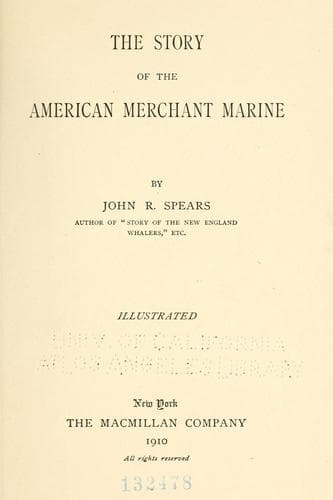
The Story of the American Merchant MarineSpears, John Randolph
History
The Story of the American Merchant Marine
Spears, John Randolph
Merchant marine -- United States
"The extraordinary fact which presses itself upon our notice from the
foregoing details by trials consists in the difference in power required
in the two vessels to produce nearly identical speed ... 2050 H. P.,
economized by the screw, propelled the _Himalaya_ at about the same speed
as 3016 H. P., transmitted by paddles, propelled the _Atrato_."
The _New York Journal of Commerce_ published the following warning in
1857:--
"While we are learning [to build steamships] England is using her
advantages. Their merchants, captains, engineers, and sailors are carrying
on our trade, and taking the bread from our mouths."
Congressman Nelson Dingley, Jr., of Maine, a prominent advocate of the
subsidy system, in an article in the _North American Review_, dated April,
1884, said:--
"At the time Great Britain accepted our invitation to participate,
on equal terms in the business of" transportation (it was in 1849),
"experiments in iron ship building and steam propulsion were going on in
that country, which, _as early as 1855, began to work a revolution in
marine architecture_.... _This revolution_ from wood to iron and sails
to steam _at once_ began to deprive the American merchant marine of" the
advantages it had enjoyed.
The total number of British steamers receiving mail pay, or subsidy, in
1857, was 121, including the vessels plying to Ireland, the Isle of Man,
the Orkneys, and other near-by points; among which was one line sending
two steamers a day over its route. (See _Nautical Magazine_, September,
1857.) The total number of steamers under the British flag, in 1857, was
2132 (Rep. Com. of Nav. for 1901, p. 472). It is manifest that the mail
pay aided the 121 steamers thus favored; it is equally manifest that
the 2011 unsubsidized steamers were not only obliged to depend on their
intrinsic merit for profit, but they were obliged to compete on unfair
terms in all the trades (like that from Liverpool to New York) where the
subsidized steamers were employed.
The progress made by the British iron screw steamer thereafter was pointed
out by John Roach, in the course of his testimony, quoted above, when he
said (p. 177) he "had found out by personal examination that there were
119 iron steamships plying between the ports of America and Great Britain.
Of that number 110 were running to the port of New York."
Public-domain text, read in full here on John Shaqi.
Reviews
Reviews
No reviews yet
Be the first to share your thoughts on this work.
Elsewhere in the archive
Join the Discussion
Join the discussion
Sign in to leave a comment or review.
Sign InorCreate an account