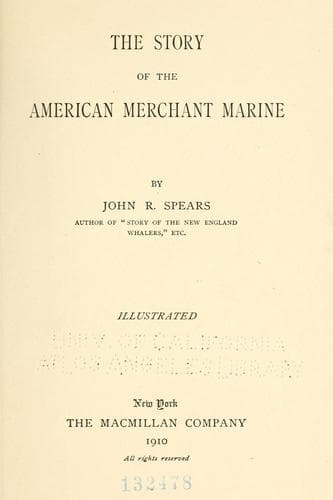
The Story of the American Merchant MarineSpears, John Randolph
History
The Story of the American Merchant Marine
Spears, John Randolph
Merchant marine -- United States
The assertion, so often made at the North, that Congressmen from the
Southern States, during the years immediately preceding the Civil War,
were united in a conspiracy to injure Northern industries in order thereby
to weaken the North and make the work of secession easier, is absolutely
without foundation in fact. It is as absurd as the similar statement to
the effect that the Secretary of the Navy (Toucey, a Connecticut man) had
scattered the ships of the navy all over the world to weaken the fighting
power of the general government. The truth is the ships were not as badly
scattered in 1860 as they had been in several of the preceding years. Thus
there were twelve ships upon the home station in 1860, but only five in
1851. Further than that, Toucey had for two years urged upon Congress the
building of seven sloops of war of a draught of only fourteen feet, and
Congress, on February 21, 1861, appropriated the money for that purpose.
These shoal-draught vessels were admirably adapted for use in the waters
along the Southern States, and that fact was pointed out during the
discussion in the House. _Nevertheless several members from the Southern
States voted for the bill._
The subsidy policy was never treated as a sectional issue in Congress.
Hamlin, of Maine, Vice-president under Lincoln, voted with the opponents
of the subsidy men. (_Globe_, June 9, 1858, p. 2837.)
Hamlin's opposition is especially significant because he represented the
great mass of unsubsidized ship-owners whose business was injured by the
subsidized ships, and who were hot in their opposition to Collins.
Then it is to be noted that a chief argument urged by these Southern men
against the payment of subsidies to the lines then in question was based
on the belief that the ships were not fit for war-ships--were, in that
respect, the shams they are now known to have been. In short, any candid
reading of the speeches shows that in this question they were inspired by
a desire to do what was best for the whole nation.
That one kind of sectional jealousy hurt the Collins line has been
pointed out by Smith, in _The Ocean Carrier_--the well-founded jealousy
of the ship-owners of Boston, Philadelphia, and Baltimore. The clipper
ship-owners of New York also bitterly opposed the Collins Line. In fact,
these unsubsidized ship-owners combined to fight the Collins lobby at
Washington, and it was their influence that struck the "terrible blow"
which Marvin says was inflicted by the Southern members of Congress.
Public-domain text, read in full here on John Shaqi.
Reviews
Reviews
No reviews yet
Be the first to share your thoughts on this work.
Elsewhere in the archive
Join the Discussion
Join the discussion
Sign in to leave a comment or review.
Sign InorCreate an account