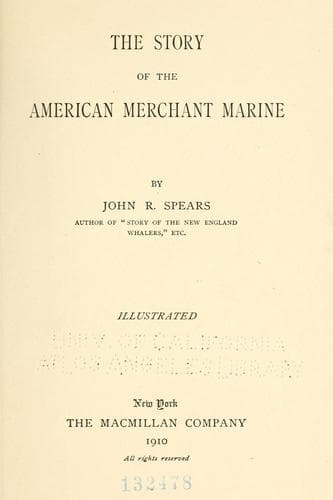
The Story of the American Merchant MarineSpears, John Randolph
History
The Story of the American Merchant Marine
Spears, John Randolph
Merchant marine -- United States
As a final reason for the decadence of the American merchant marine,
note that the conditions of life in the American forecastle had greatly
changed, and that this change began when the American ships were winning
their laurels. With the advent of the packet system the "private venture"
method of adding to a sailor's income disappeared, and with it one strong
inducement to the young men who thought of going to sea. Then the old
custom of making the forecastle a schoolroom, with the ship's officers
serving as instructors in navigation, died out. The very prosperity
of the American merchant marine served to deteriorate the quality of
American seamen, for the number of ships increased much more rapidly
than the seafaring population. Foreign sailors were employed for lack
of enough Americans. In time even the number of experienced foreigners
was insufficient. Captain J. S. Clark testified before the committee of
Congress mentioned above that he had taken a ship to sea with "but two
men out of a crew of sixty who could steer."
With the employment of foreigners the pleasant relations that had existed
between the forecastle and cabin came to an end. The officers who had
been shipmates with crews of ambitious young Americans found the foreign
sailors, with their lack of ambition--with a certain slowness of movement,
in fact--exasperating, especially when topsails were to be reefed after
"carrying on" somewhat too long! This exasperation, with race or national
prejudices to increase it, was what led to the use of the belaying pin
and the pump-brake for the "encouragement" of sailors who failed to
"show willing." Naturally, as time passed, the treatment of sailors grew
worse, and an American statute which required the sailor to prove malice
or revenge on the part of an assailing officer, when he had the officer
arrested for ill treatment, did but add to the horrors of a passage on a
driven ship. Dana, in his _Two Years Before the Mast_, describes mildly
the treatment which common sailors received in American ships in his day.
Jewell's _Among Our Sailors_ describes the cruelty more in detail. It was
a common thing for captains to torture men, and men were sometimes killed
by the brutality which they could not escape. And while the conditions
in the American forecastle were growing worse, those in the British
were growing better. In 1869 Captain Cyrus F. Sargeant, the well-known
ship-owner, testified that "the wages of sailors are lower in an American
ship than in an English ship." It is well known that the port makes the
wages for the forecastle, but it was true, then, that seamen on British
liners, at least, saved more money in a year than the men on American
ships.
The testimony taken before the Merchant Marine Commission, in 1904 (p.
1263), contains the following paragraph, the truthfulness of which was
not disputed:--
Public-domain text, read in full here on John Shaqi.
Reviews
Reviews
No reviews yet
Be the first to share your thoughts on this work.
Elsewhere in the archive
Join the Discussion
Join the discussion
Sign in to leave a comment or review.
Sign InorCreate an account