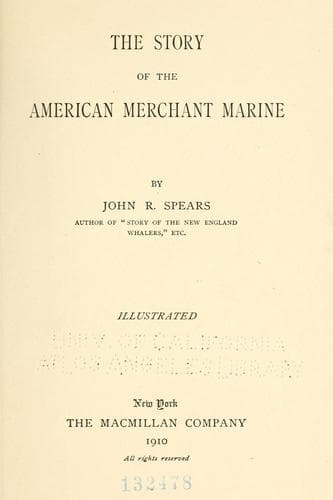
The Story of the American Merchant MarineSpears, John Randolph
History
The Story of the American Merchant Marine
Spears, John Randolph
Merchant marine -- United States
Another American adventure at sea that is of interest here was the
evolution of the United Fruit Company. Individual dealers in perishable
products of the tropics found it profitable to unite in gathering bananas
and other fruits, and in chartering ships to bring them to the United
States. As the business continued to increase, the need of swift ships,
and for fittings to preserve the fruit in the best condition, led to the
building of special kinds of ships (chiefly under foreign flags) and of
machinery for loading and unloading the cargoes at the terminals. In the
meantime, the speedy ships employed had proved attractive to passengers,
and because passengers could be carried without decreasing the efficiency
of the ships as fruit carriers, efforts were made to increase this branch
of the traffic. In time the company built hotels for the comfort of
the passengers at points in the tropics where a comfortable hotel was a
surprise to the experienced traveller. Then because the well-contented
fruit farmers of the tropics were unwilling to keep up with the demands of
the trade in either the quantity or the quality of the fruit, the company
bought land and produced the cargoes needed by their ships.
The Standard Oil Company employs nearly a hundred ships (chiefly under
foreign flags), which it has built for the purpose, to transport its
products to foreign countries. And there are other corporations that own
ships as parts of their business equipment.
These American enterprises are of the utmost importance to the story of
the American merchant marine, because they are the most modern features of
our water-borne traffic. The great corporation is doing an _ever growing_
share of the world's work, and the growth is an economic evolution that
must be forwarded as well as controlled. In spite of the prevailing fear
of great aggregations of wealth, it is worth while to inquire whether a
further combination of corporate interests might not help on a revival
of the American merchant marine. Suppose that a ship-building "trust"
were united with the steel-making "trust" and the aggregation were to
make a traffic agreement with a combination of railroads extending from
the Atlantic to the Pacific, under which special low freight rates were
obtainable; is it not conceivable that this powerful corporation might
solve the problem of ships able to compete on deep water? Although the law
now prohibits such combinations as this, may we not hope that the American
people will yet learn how to preserve themselves from oppression, and the
fear of it, without hampering the men who are able and eager to do the
world's work on the world's terms?
Public-domain text, read in full here on John Shaqi.
Reviews
Reviews
No reviews yet
Be the first to share your thoughts on this work.
Elsewhere in the archive
Join the Discussion
Join the discussion
Sign in to leave a comment or review.
Sign InorCreate an account