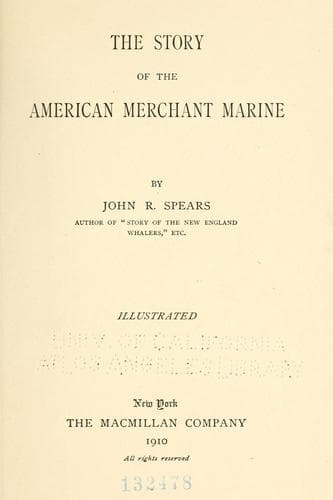
The Story of the American Merchant MarineSpears, John Randolph
History
The Story of the American Merchant Marine
Spears, John Randolph
Merchant marine -- United States
Then consider the effect of the tides in the business world upon the
carrying-trade. After the war with the Boers the freight rates went to
pieces. Owners ceased building new tonnage. The ship-builders, to keep
their forces together, offered to construct the best of modern vessels at
cost of construction. Thereupon new capital came into the trade, and some
men of experience also placed orders. In this way an excess of tonnage
was kept afloat. Meantime much old tonnage in the progressive countries
like England and Germany was placed on the market at forced sale, and
these ships were bought by continental owners who patched them up ("cheap
repairs for the cheap ones"), and sent them, with cheap crews, looking for
cargoes. It must be kept in mind that Chinese owners, who can hire stokers
at $6 a month, are competing in the world's traffic, as well as owners
who have to pay $40 a month for the same kind of work. Where the Chinese
owner can make money, and the owner of the best of modern freighters can
live, and even make a lucky stroke, now and then, the owner of the average
tramp keeps her running because the losses while she is in commission are
less than when she is laid up in ordinary. The tramp traffic is precisely
like mining in that the luck of the few keeps the many trying. Moreover
the trend of business has been, for some time, away from tramps and into
regular line ships, and that is a fact worth serious consideration.
The average profit of the lines of steamers is well set forth in the
statement of the Cunard Company, unless, indeed, that statement is more
favorable than the average facts warrant. The Hamburg-American Line
dividends during the past fourteen years have averaged 5¾ per cent per
annum, and it is likely that but one other ship-owning corporation has
done as well on deep water. It is a world's traffic even for a line that
plies between New York and Liverpool only. The price that a Swedish tramp
will accept for wheat in the River Plate, and the rate which the Japanese
will accept on the coast of China, both affect the North German Lloyd at
Bremen. A few lines, especially those having special trades, make good
dividends. The United Fruit Company's ships are among the exceptions
because of the peculiarities of the business. But every ship-owner knows
that on the average there is no great part of the world's work that pays
smaller dividends than carrying cargoes across deep water.
The people of the United States, before taxing themselves to add to the
congestion upon the high seas, should ask themselves whether success, when
attained, will be worth the cost. Would a sensible American farmer, able
to earn $3 a day grafting orchards, work overtime in order to compete with
a foreign ditch digger receiving $1.50?
Public-domain text, read in full here on John Shaqi.
Reviews
Reviews
No reviews yet
Be the first to share your thoughts on this work.
Elsewhere in the archive
Join the Discussion
Join the discussion
Sign in to leave a comment or review.
Sign InorCreate an account