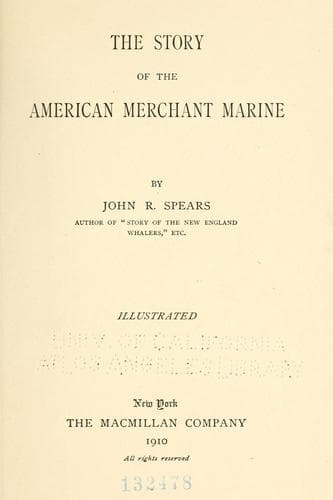
The Story of the American Merchant MarineSpears, John Randolph
History
The Story of the American Merchant Marine
Spears, John Randolph
Merchant marine -- United States
A feature of these ships to be considered is that they are all built for
passing through certain shoal channels, the Welland Canal, and the canal
at the rapids at the outlet of Lake Superior, for example. These channels
have compelled the designers to adopt one cross-section of hull for all
ships (at least below the water-line), and that cross-section is the
largest that will pass through the channels. Because of this similarity
of models the lake builders have been able to carry specialization in
the work of construction as far as any builders in the world, and much
further than it is carried in the Atlantic coast yards, where builders
may have a battleship, a harbor tug, and a side-wheel passenger boat on
adjoining ways. The lake ships can be built for the lowest price of any
in the United States.
Contemplation of these facts, and upon the further fact that lake
engineers seemed to be about the best the world had ever seen, led the
lake capitalists to organize the American Navigation Company, which built
two large cargo carriers, sent them down to salt water, and entered the
general cargo trade. Those vessels were among the most economical ever
built in the United States, all things considered, _but they were unable
to compete with the European ship_.
A story told by A. B. Wolvin to the Merchant Marine Commission is
significant here. A company of which he was president operated a line of
steamers from Duluth and Chicago to Montreal and Quebec. The steamers
numbered ten of the maximum size for passage through the Welland
Canal--250 by 42 feet large, with a draft of fourteen feet, and a
carrying capacity of 2200 tons. The cost of these ships, built under the
best American conditions of specialization, was $140,000 each, and the
operating expense was $135 a day each. While the company was engaged in
its work, a steamship man from Sweden came and offered to put on twelve
ships of the same size, each at a charter price of $2900 per month. His
ships cost but $90,000 each, and the wages of crew and other operating
expenses were so much lower than the American standard that he could make
money at a charter price of $1000 a month less than the cost of operating
the American ships. Having used these Swedish ships long enough to know
them (for it was necessary to accept the offer to keep the Swede from
starting in opposition), Captain Wolvin testified:--
"They are better from the standpoint of construction.... The vessels carry
well; they run well. We have no trouble with the crews."
The crew of the Swedish ship numbered seventeen; that of the American,
twenty-two. And the Swedish wage was far less.
The bearing of these facts in any consideration of the power of the
ship-owners who are now in control of the deep water traffic of the world
is obvious.
Public-domain text, read in full here on John Shaqi.
Reviews
Reviews
No reviews yet
Be the first to share your thoughts on this work.
Elsewhere in the archive
Join the Discussion
Join the discussion
Sign in to leave a comment or review.
Sign InorCreate an account