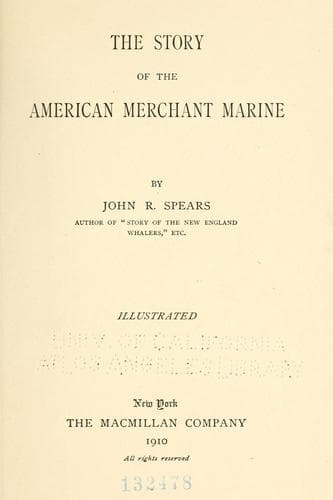
The Story of the American Merchant MarineSpears, John Randolph
History
The Story of the American Merchant Marine
Spears, John Randolph
Merchant marine -- United States
As a system for modern adoption "discrimination" is objectionable for
three reasons. One is that it provides at best for keeping our ships in
trades between home and foreign ports only; it does not provide for trade
between foreign ports. Next it is a system for supporting ships that are
confessedly inferior to those already in the trades--it places a premium
upon inefficiency. Last of all it is a system that must excite all foreign
governments to retaliation; and that those governments will be eager to
retaliate, and that they will find ways enough for doing so, is beyond
doubt. In connection with this statement it is necessary to keep in mind
that we shall soon cease to export wheat in any form, and the growth of
population is so great that we shall soon cease to export other, perhaps
all other, food products. Before inviting retaliation we must look ahead.
Indirect discrimination has been proposed. Under this the ships of any
country were to be permitted to bring in without discrimination goods
produced under their flag; but goods brought from any other country were
to be subjected to a discriminating tax. Any analysis of our imports,
however, shows that if British goods were taxed when brought here in any
but British ships, all such goods would be forced into British ships at
once, to the great advantage of the British shipping. They could not at
present, nor for years to come, be forced into American cargo carriers.
As the system would in like manner help German shipping, the policy would
but make our task the harder.
Before considering the policy of paying direct subsidies a glance at the
oft-repeated assertion that our shipping is "our one unprotected industry"
seems necessary. What does "protection" provide for any industry, or what
does it pretend to provide? Simply the home market--this and nothing more,
at best. This is done by laying a tariff upon imports. But the American
shipping is now and always has been protected that far--absolutely
protected, in fact, by prohibition. The importation of ships has been
forbidden, and the use of foreign ships in the "home market" has been
reserved to home-built ships for nearly 100 years. If "protection" could
enable any industry to expand from the "home market" to the foreign, then
the coasting trade industry should have expanded long since over all the
world. Unhappily, however, the profit found in well-protected industries
does but tend to make the beneficiaries contented, and willing to let well
enough alone.
Public-domain text, read in full here on John Shaqi.
Reviews
Reviews
No reviews yet
Be the first to share your thoughts on this work.
Elsewhere in the archive
Join the Discussion
Join the discussion
Sign in to leave a comment or review.
Sign InorCreate an account