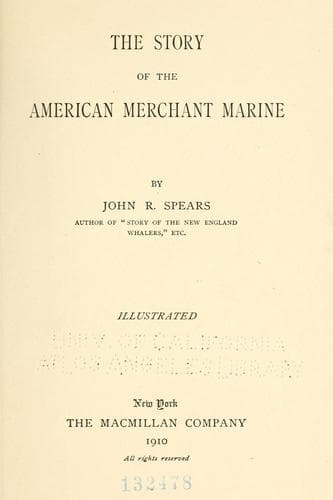
The Story of the American Merchant MarineSpears, John Randolph
History
The Story of the American Merchant Marine
Spears, John Randolph
Merchant marine -- United States
Accepting the Commission's statement that the subsidies would prove
sufficient to place the more expensive American ships upon an equality
with the foreign, and "a little more," as was said, it may be assumed that
the new lines would eventually employ sixty or seventy ships. At $5 a ton
the $10,000,000 might put afloat from 300 to 400 modern cargo carriers.
Thus we should, at best, about double our present registered fleet,
which, in 1908, numbered 478 ships. But if we compare that fleet with
the German, which now numbers more than 2500 ships, or with the British,
which now numbers more than 4000, we shall see that even under the best
circumstances we should yet be a far cry from the supremacy of which we
made boast in other days. Indeed, the fleet of liners would not number as
many ships as the Standard Oil Company now employs to carry abroad its
products, while the fleet of cargo carriers could not be compared, with
any satisfaction, to the fleet now in use by the allied German companies
of which mention has been made.
And the ships thus to be set afloat, as they crossed the seas, would
proclaim to the world that they were in the carrying trade, not by right
of efficiency, but by grace of a subsidy.
But now we are to consider whether any subsidy heretofore proposed would
really be sufficient to sustain either liner or tramp. The effect of such
ships upon freight rates, for instance, was stated before the Merchant
Marine Commission, by B. N. Baker, formerly president of the Atlantic
Transport Company, and an advocate of the subsidy system. He said:--
"If you added any more to the open sea traffic (the foreign traffic) of
the United States than 100,000 tons a year you would so demoralize the
general carrying business in rates, both as to freight and passengers, it
would be so unprofitable that no one could go into it, _unless you would
double, and triple that compensation_."
The effect of that building programme upon the organized mechanics of our
shipyards--the strikes for higher wages, and the consequent increase of
prices--need only be mentioned.
Then figure up the expense of the war between the lines from New York
to South Africa in 1902, wherein ships lost $15,000 in a single voyage.
Manifestly the American liners would need all of their subsidy ($15,625,
per voyage) to meet the reductions in freight rates which the opposition
would make. They would thus be no better off than they would be if
they were permitted to enter the trade on even terms with the present
lines--without war and without subsidy. The line to Brazil would yet have
to face the disadvantages due to the triangular service which British
ships maintain, though the decreasing exports of American food products
would reduce those disadvantages somewhat.
Public-domain text, read in full here on John Shaqi.
Reviews
Reviews
No reviews yet
Be the first to share your thoughts on this work.
Elsewhere in the archive
Join the Discussion
Join the discussion
Sign in to leave a comment or review.
Sign InorCreate an account