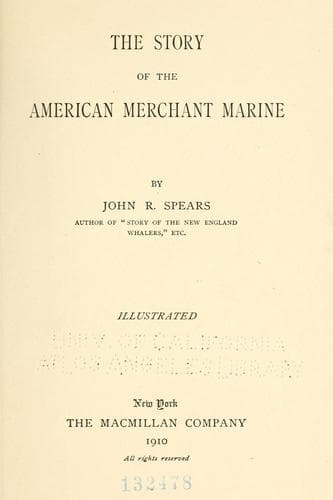
The Story of the American Merchant MarineSpears, John Randolph
History
The Story of the American Merchant Marine
Spears, John Randolph
Merchant marine -- United States
The same argument may be made for the maintenance of swift lines to both
coasts of South America, where we have the Monroe Doctrine and the Panama
Canal to defend. If we establish these lines, a war of subsidies is to be
expected, and the well-established and powerful companies already in the
trades will be wholly unscrupulous in their opposition, not because their
present profits are high, but because they are low; a division of the
traffic will still further reduce the profits which are already too narrow
for comfort. We may be sure, too, that extravagance and inefficiency of
the Collins kind will be found in the management of some of our companies;
but as a diplomatic and military measure the experiment seems to be
worth making. We have a very good precedent in the action of Germany in
establishing a line to its Pacific possessions by a subsidy of a million
a year, which is given for the precise reasons urged herein. It will cost
the United States many times as much as it does Germany, but one who looks
at the matter broadly may well suppose that such an increase of expenses,
avowedly made as a measure for increased military efficiency, might be
worth while, in the end, as a peace measure. For we shall be obliged in
any event, to go on increasing our naval budget to keep even with the
growth of European navies, until the war burden becomes intolerable in
Europe as well as in the United States; and then we shall have measures
for preserving peace more rational than those now in vogue. The sooner
the burden is made intolerable the better.
But while we can provide an ample fleet of naval auxiliaries by means of
subsidies, if we are willing to pay the price, let no one suppose that
such a measure will give the country any share of the world's traffic
worth consideration, not to more than mention supremacy upon deep water.
One method by which the Merchant Marine Commission thought to increase
American sea power is memorable. A heavy tonnage tax was to be laid upon
all ships coming from foreign countries to American ports, and the money
so raised was to be paid to American ships in the foreign trade in return
for carrying a certain proportion of American citizens enrolled as members
of a corps of naval volunteers. The measure looked toward an increase in
the number of American seamen, but it did not become a law.
Public-domain text, read in full here on John Shaqi.
Reviews
Reviews
No reviews yet
Be the first to share your thoughts on this work.
Elsewhere in the archive
Join the Discussion
Join the discussion
Sign in to leave a comment or review.
Sign InorCreate an account