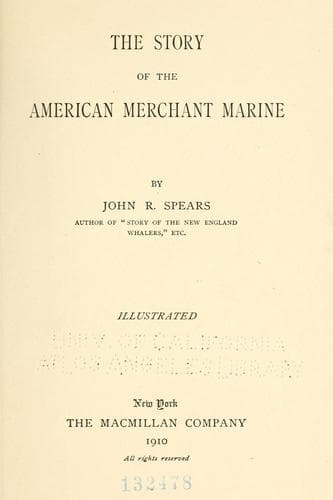
The Story of the American Merchant MarineSpears, John Randolph
History
The Story of the American Merchant Marine
Spears, John Randolph
Merchant marine -- United States
Having obtained a contract for dredging some of the slips along the
Philadelphia water front, he built a scow, 30 × 12 feet large, to carry
the dredge. The scow was put together at his shop, which was located a
mile from the Schuylkill. When done, he mounted a steam engine, (5 × 19
inches large), on its deck, placed temporary wooden axles with temporary
wooden wheels underneath, connected the axles and engine shaft, and then
steamed away to the river. There he removed the wheels and put a paddle
wheel at the stern for use afloat. Then he launched his scow, steamed
down the Schuylkill and up to the slips he was to dredge. The engine was
thereafter used in the work of dredging. Although that was in 1804, the
people were not yet ready for steam navigation. The only practical result
of the work of Evans was the adoption of the high-pressure engine, so
called. His engine had no condenser. It exhausted its steam into the open
air, and this style of engine was found to be best adapted for use on the
steamboats of the Western rivers, later on.
In the meantime Robert Fulton, who was to succeed, had been at work.
Fulton was a Pennsylvania artist who had shown so much talent that he
went to England to study under Benjamin West. In the meantime, however, he
had been greatly interested in mechanics, and had dreamed of steamboats.
In London his thoughts turned more and more to mechanics, and in 1793 he
abandoned art to take up his life-work.
In the popular view the most interesting chapter in Fulton's life is
that relating the story of the first voyage of his first steamship; but
for the encouragement of struggling inventors the most important facts
in his life are those showing how he went about his task. For Fulton
made a thorough study of his subject; while experimenting for himself
he took care to learn as much as possible about what others had already
done in the same line. In modern days, when every important invention is
known to be a development from crude ideas and appliances into a perfect
design, it seems not a little curious to read that in Fulton's time his
method of work--his determination to learn his subject thoroughly before
building--was considered not quite creditable. Invention, it was thought,
consisted in working out an inspiration in the dark!
Fulton's first effort to build a steamship was made in 1794, when he
went to Paris and tried to induce the National Convention to take up the
invention, and thus "deliver France and the whole world from British
oppression." Of course the chaotic conditions in Paris prevented the
realization of his hopes.
Public-domain text, read in full here on John Shaqi.
Reviews
Reviews
No reviews yet
Be the first to share your thoughts on this work.
Elsewhere in the archive
Join the Discussion
Join the discussion
Sign in to leave a comment or review.
Sign InorCreate an account