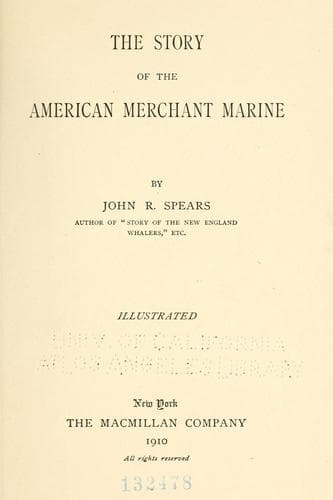
The Story of the American Merchant MarineSpears, John Randolph
History
The Story of the American Merchant Marine
Spears, John Randolph
Merchant marine -- United States
Two notable improvements were made in the engines in the meantime. Robert
L. Stevens designed a light wrought-iron "walking beam" to replace the
heavy cast-iron beam that was previously used. Then in 1824 James P.
Allaire, who had made a reputation as an engine builder, brought out
a "compound" engine. A compound engine has two or more cylinders of
different diameters coupled to the one shaft. In the Watt engines the
steam was conducted from the boiler to one end of the cylinder and allowed
to flow in until the piston was driven almost to the opposite end. Then it
was shut off and the way to the condenser was opened. Later it was found
that if the flow of steam was cut off at half the length of stroke and
the steam already in the cylinder was allowed to work by expansion, the
total power of the engine was reduced only a little, while the saving of
coal was very great. While thinking of this fact, it occurred to Allaire
that the principle involved might be used to better advantage if the steam
was taken at full pressure into a small cylinder and exhausted thence
into a second and larger one to work by its expansive power. The _Henry
Eckford_, the _Sun_, and a number of others were supplied with engines on
this principle. The _Eckford_ had a small cylinder 12 inches in diameter
and a large one of 24. Both had the same stroke, of course. But, curiously
enough, it was not until about 1870 that compound engines became the
fashion.
The racing era, as one may call it, began on the Hudson about 1835, the
year that Daniel Drew became interested in the Hudson River steamers.
Racing had been done before the consolidation of 1832, but it was mild
in comparison with that under Drew's initiation. An unreasoning mania for
speed took possession of the public as well as of the owners of steamers.
Though no practical end was to be served by the saving of an hour in
the time required in the trip from New York to Albany, every sacrifice
was made and every risk was taken to secure it. Instead of going to a
pier or dock to land way-passengers at the towns along the river, the
unfortunates were dumped into a small skiff that was towed at the end of
a long rope. Then, as the steamer ran in close, but not too close, to the
landing, the man in charge of the skiff, using a steering oar, sheered it
within a few feet of the landing, and the passengers were told to jump.
And jump they did. Of course a few fell into the water at every trip;
perhaps some were drowned thereby. But the steamer's reputation for making
quick passages was maintained, and for a long time the public protested
in vain. When legislation was invoked (1842) the act was opposed as an
unwarranted attempt to interfere with private business which could much
better regulate itself!
Public-domain text, read in full here on John Shaqi.
Reviews
Reviews
No reviews yet
Be the first to share your thoughts on this work.
Elsewhere in the archive
Join the Discussion
Join the discussion
Sign in to leave a comment or review.
Sign InorCreate an account