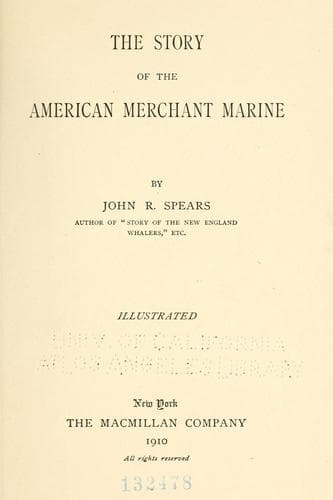
The Story of the American Merchant MarineSpears, John Randolph
History
The Story of the American Merchant Marine
Spears, John Randolph
Merchant marine -- United States
In 1813 Fulton and his associates reached out for alongshore trade by
building the _Fulton_ for use between New York and New Haven, but because
of the activity of the British war-ships on the blockade, she did not make
her first trip until March 21, 1815, when she carried thirty passengers
to New Haven in eleven hours.
The _Massachusetts_ was the first steamer in use at Boston. She began
plying to Salem in 1817. In the same year the _Fire Fly_ was sent from New
York to Rhode Island, where she was used between Providence and Newport.
Rounding Point Judith in this vessel was considered a feat showing
extraordinary courage, and this, too, among sailors who thought nothing
of a voyage around the world in a ship less than a hundred feet long.
In 1818 the _Walk-in-the-water_ was built at Black Rock, (now a part of
Buffalo), on the Niagara River, for use on the Great Lakes. When ready
for her trial trip, she was unable to stem the river current until eight
yoke of oxen were brought to her assistance, but once on the lake she did
well. She made her first trip to Detroit, starting on August 20, 1818, and
covered the distance in about forty hours, using a cord of wood an hour.
By the annual report of the Commissioner of Navigation it appears that
four steamboats, aggregation 457 tons, were built in the United States
in 1812, the first year for which there is a record. In 1813 seven of
an aggregate tonnage of 1430 were built, and in 1819 the number was
twenty-eight, with a tonnage of 7291. More than a hundred had been built
in all. This expansion was almost but not quite all made upon inland or
sheltered waters. Fulton had looked toward the high seas. He had built a
steamship, which he named the _Emperor Alexander_, to sell to the Russian
government, but the War of 1812 prevented his trying to navigate her
across the ocean, and she was eventually worn out at home. During the war
he built the huge war steamer _Demologos_, a vessel fit to go along the
coast, and crude as she was, she would have changed the manner of war at
sea had she been set afloat a year sooner.
The year 1819 is especially memorable because a transatlantic steam
passage was then made. It appears that Captain Moses Rogers was the
originator of the venture. In 1818 Francis Fickett built a common sailing
ship at New York that was 100 feet long by 28 broad and 14 deep. Rogers
had had the honor of first navigating the sea with a steamer, and he had
been selected in 1816, because of his reputation for courage and skill, to
take the steamer _New Jersey_ from New York to the Chesapeake, a voyage
thought to be full of danger for such a vessel. He was now inspired with
the ambition to be the first to drive a steamship across the Atlantic,
and after a look at the ship that Fickett was building, he persuaded
Scarborough & Isaacs, ship merchants of Savannah, to buy and fit her with
a steam engine for use between Savannah and Liverpool.
Public-domain text, read in full here on John Shaqi.
Reviews
Reviews
No reviews yet
Be the first to share your thoughts on this work.
Elsewhere in the archive
Join the Discussion
Join the discussion
Sign in to leave a comment or review.
Sign InorCreate an account