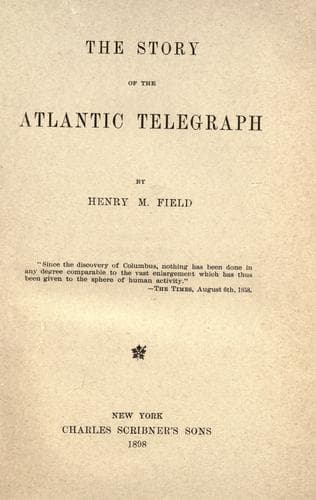
The Story of the Atlantic TelegraphField, Henry M. (Henry Martyn)
History
The Story of the Atlantic Telegraph
Field, Henry M. (Henry Martyn)
Transatlantic cables
"During the morning of Friday, the thirtieth, every thing went
well; the ship had been kept at the speed of about five knots,
the cable paid out at about six, the average angle with the
horizon at which it left the ship being about fifteen degrees,
while the indicated strain upon the dynamometer seldom showed
more than sixteen hundred pounds to seventeen hundred pounds.
Observations made at noon showed that we had made good ninety
miles from the starting-point since the previous day, with an
expenditure, including the loss in lowering the splice and
during the subsequent stoppages, of one hundred and thirty-five
miles of the cable. During the latter portion of the day the
barometer fell considerably, and toward the evening it blew
almost a gale of wind from the eastward, dead ahead of course.
As the breeze freshened, the speed of the engines was gradually
increased, but the wind more than increased in proportion, so
that, before the sun went down, the Agamemnon was going full
steam against the wind, only making a speed of about four knots
an hour. During the evening topmasts were lowered, and spars,
yards, sails, and indeed every thing aloft that could offer
resistance to the wind, was sent down on deck; but still the
ship made but little way, chiefly in consequence of the heavy
sea, though the enormous quantity of fuel consumed showed us
that, if the wind lasted, we should be reduced to burning the
masts, spars, and even the decks, to bring the ship into
Valentia.
"It seemed to be our particular ill-fortune to meet with
head-winds whichever way the ship's head was turned. On our
journey out we had been delayed, and obliged to consume an
undue proportion of coal, for want of an easterly wind, and now
all our fuel was wanted because of one. However, during the
next day the wind gradually went around to the south-west,
which, though it raised a very heavy sea, allowed us to husband
our small remaining store of fuel.
Public-domain text, read in full here on John Shaqi.
Reviews
Reviews
No reviews yet
Be the first to share your thoughts on this work.
Elsewhere in the archive
Join the Discussion
Join the discussion
Sign in to leave a comment or review.
Sign InorCreate an account