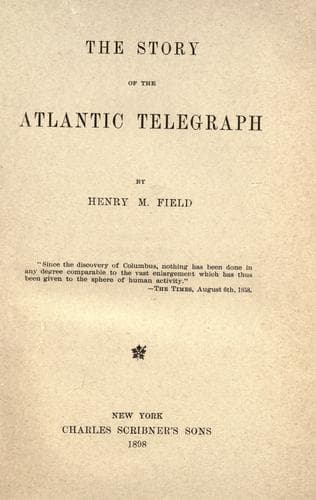
The Story of the Atlantic TelegraphField, Henry M. (Henry Martyn)
History
The Story of the Atlantic Telegraph
Field, Henry M. (Henry Martyn)
Transatlantic cables
In this application they might have been successful, but for an untoward
event, which dampened the confidence of the public in all submarine
enterprises--the failure of the Red Sea Telegraph. The British
Government, anxious to forward communication with India, had given that
Company an unconditional guarantee, on the strength of which the capital
was raised, and the cable manufactured and laid. But in a short time it
ceased to work, a loss which the treasury of Great Britain had to make
good. To the public, which did not understand the cause of the failure
to be the imperfect construction of the cable, the effect was to impair
confidence in all long submarine telegraphs. Of course, after such an
experience, the Government was not disposed to bind itself by such
pledges again. It was, however, ready to aid the enterprise by any safe
means. It therefore increased its subsidy from fourteen thousand pounds
to twenty thousand pounds; and guaranteed eight per cent on six hundred
thousand pounds of new capital for twenty-five years, with only one
condition--_that the cable should work_. This was a liberal grant, and
under the circumstances, was all that could be expected.
Still further to encourage the undertaking, it ordered new soundings to
be taken off the coast of Ireland. These were made by Captain Hoskins,
of the Royal Navy, and dispelled the fears which had been entertained of
a submarine mountain, which would prove an impassable barrier in the
path of an ocean telegraph.
But the greatest service which the British Government rendered, was in
the long course of experiments which it now ordered, to determine all
the difficult problems of submarine telegraphy. In 1859, the year after
the failure of the first Atlantic cable, the Board of Trade appointed a
committee of the most eminent scientific and engineering authorities in
Great Britain to investigate the whole subject. This was composed of
Captain Douglas Galton, of the Royal Engineers, then of the War Office,
who represented the Government; Professor Wheatstone, the celebrated
electrician; William Fairbairn, President of the British Association
for the Advancement of Science; George Parker Bidder, whose name ranks
with those of Stephenson and Brunel; C. F. Varley, who, in the practical
working of telegraphs, had no superior in England; Latimer Clark and
Edwin Clark, both engineers, who had had great experience in the
business of telegraphing; and George Saward, the Secretary of the
Atlantic Telegraph Company.
Public-domain text, read in full here on John Shaqi.
Reviews
Reviews
No reviews yet
Be the first to share your thoughts on this work.
Elsewhere in the archive
Join the Discussion
Join the discussion
Sign in to leave a comment or review.
Sign InorCreate an account