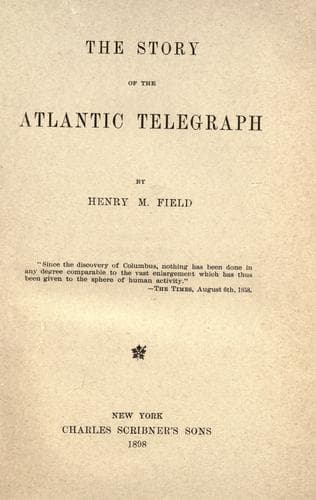
The Story of the Atlantic TelegraphField, Henry M. (Henry Martyn)
History
The Story of the Atlantic Telegraph
Field, Henry M. (Henry Martyn)
Transatlantic cables
It may well be believed that it was no small affair to equip such an
expedition. Beside the enormous burden of the cable itself, the Great
Eastern had to take on board seven or eight thousand tons of coal,
enough for a fleet, to feed her fires. Then she carried about five
hundred men, for whom she had to make provision during the weeks they
might be at sea. The stores laid in were enough for a small army.
Standing on the wheel-house, and looking down, one might fancy himself
in some large farm-yard of England. There stood the motherly cow that
was to give them milk; and a dozen oxen, and twenty pigs, and a hundred
and twenty sheep, while whole flocks of ducks and geese, and fowls of
every kind, cackled as in a poultry-yard. Beside all this live stock,
hundreds of barrels of provisions, of meats and fruits, were stored in
the well-stocked larder below. Thus laden for her voyage, the Great
Eastern had in her a weight, including her own machinery, of twenty-one
thousand tons--a burden almost as great as could have been carried by
the whole fleet with which Nelson fought the battle of Trafalgar.
As the time of departure drew near, public curiosity was excited, and
there was an extraordinary desire to witness the approaching attempt.
The Company was besieged by applications from all quarters for
permission to accompany the expedition. Had these requests been granted,
on the scale asked, even the large dimensions of the Great Eastern could
hardly have been sufficient for the crowds on board. The demand was most
pressing for places for newspaper correspondents. These came not only
from England, but from France and America. Almost every journal in
London claimed the privilege of being represented. The result was what
might have been expected. As it was impossible to satisfy all, and to
discriminate in favor of some, and exclude others, would seem partial
and unjust, they were finally obliged to exclude all. Of course this
gave great offence. There was an outcry in England and in the United
States at what was denounced as a selfish and suicidal policy. But it is
doubtful whether any other possible course would have given better
satisfaction.
Whether the Managers erred in this or not, it should be said that they
applied the same inexorable rule to themselves--even Directors of the
Company being excluded, unless they had some special business on board.
Public-domain text, read in full here on John Shaqi.
Reviews
Reviews
No reviews yet
Be the first to share your thoughts on this work.
Elsewhere in the archive
Join the Discussion
Join the discussion
Sign in to leave a comment or review.
Sign InorCreate an account