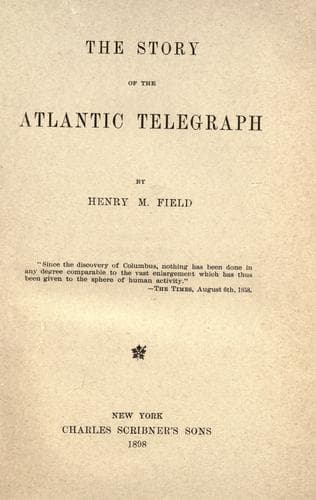
The Story of the Atlantic TelegraphField, Henry M. (Henry Martyn)
History
The Story of the Atlantic Telegraph
Field, Henry M. (Henry Martyn)
Transatlantic cables
Yet the Company was not unmindful of the anxiety of the public for news,
and since it could not give a place to many correspondents, it engaged
one, and that the best--W. H. Russell, LL.D., the well-known
correspondent of the London Times in the Crimea and in India. This
brilliant writer was engaged to accompany the expedition--not to praise
without discrimination, but to report events faithfully from day to day.
He was accompanied by two artists, Mr. O'Neill and Mr. Dudley, to
illustrate the scenes of the voyage. Thus the Company made every
provision to furnish information and even entertainment to the public.
Several of these gentlemen afterward wrote accounts for different
magazines--Blackwood, Cornhill, and Macmillan's. Their different
reports, and especially the volume of Dr. Russell, which combines the
accuracy and minuteness of a diary kept from day to day, with brilliant
descriptions, set off by illustrations from drawings of Mr. Dudley,
furnish the public as full and complete an account as if there had been
a special correspondent for every journal of England and America.
But if the public at large were very properly excluded, the organization
on board was perfect and complete. At the head was Captain Anderson, of
whom we have already spoken. As his duties would be manifold and
increasing, he had requested the aid of an assistant commander, and
Captain Moriarty, R. N., who had been in the Agamemnon in 1858, was
permitted by the Admiralty to accompany the ship, and to give the
invaluable aid of his experience and skill. The government also
generously granted two ships of war, the Sphinx and the Terrible, to
attend the Great Eastern. Thus the whole equipment of the expedition was
English. Of the five hundred men on board the Great Eastern, there was
but one American, and that was Mr. Field.
The engineering department was under charge of Mr. (now Sir) Samuel
Canning, who, as the representative of the Telegraph Construction and
Maintenance Company, was chief in command of all matters relating to
laying the cable. For this responsible position no better man could have
been chosen. Before the voyage was ended, he had ample opportunity to
show his resources. He was ably seconded by Mr. Henry Clifford. Both
these gentlemen had been on board the Agamemnon in the two expeditions
of 1858. They had since had large experience in laying submarine cables
in the Mediterranean and other seas. It was chiefly by their united
skill that the paying-out machinery had been brought to such perfection,
that throughout the voyage it worked without a single hitch or jar. They
had an invaluable helper in Mr. John Temple.
Public-domain text, read in full here on John Shaqi.
Reviews
Reviews
No reviews yet
Be the first to share your thoughts on this work.
Elsewhere in the archive
Join the Discussion
Join the discussion
Sign in to leave a comment or review.
Sign InorCreate an account