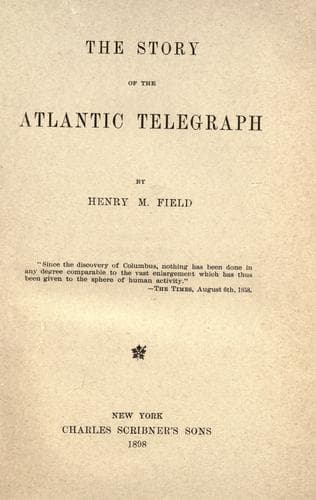
The Story of the Atlantic TelegraphField, Henry M. (Henry Martyn)
History
The Story of the Atlantic Telegraph
Field, Henry M. (Henry Martyn)
Transatlantic cables
All now went well till Saturday, the twenty-ninth, when a little after
noon there was again a cry from the ship, as if once more the cable were
wounded and in pain. This time the fault was more serious than before.
The electricians looked very grave, for they had struck "dead earth,"
that is, the insulation was completely destroyed, and the electric
current was escaping into the sea.
As the fault had gone overboard, it was necessary to reverse their
course, and haul in till the defective part was brought up from the
bottom. This time it was more difficult, for they were in water two
miles deep. Still the cable yielded slowly to the iron hands that drew
it upward; and after working all the afternoon, about ten o'clock at
night they got the fault on board. The wounded limb was at once
amputated, and joining the parts that were whole, the cable was made new
and strong again. Thus ended a day of anxiety. The next morning, which
was the second Sabbath at sea, was welcomed with a grateful feeling
after the suspense of the last twenty-four hours.
On Monday, the miles of cable that had been hauled up, and which were
lying in huge piles upon the deck, were subjected to a rigid
examination, to find out where the fault lay. This was soon apparent.
Near the end was found a piece of wire thrust through its very heart, as
if it had been driven into it. All looked black when this was
discovered, for at once it excited suspicions of design. It was remarked
that the same gang of workmen were in the tank as at the time of the
first fault. Mr. Canning sent for the men, and showing them the cable
pierced through with the wire, asked them how it occurred. Every man
replied that _it must have been done by design_, even though they
accused themselves, as this implied that there was a traitor among them.
It seemed hard to believe that any one could be guilty of such devilish
malignity. Yet such a thing had been done before in a cable laid in the
North Sea, where the insulation was destroyed by a nail driven into it.
The man was afterward arrested, and confessed that he had been hired to
do it by a rival company. The matter was the subject of a long
investigation in the English courts. In the present case there were many
motives which might prompt to such an act. The fall in the stock on the
London Exchange, caused by a loss of the cable, could hardly be less
than half a million sterling. Here was a temptation such as betrays
bold, bad men into crime. However, as it was impossible to fix the deed
on any one, nothing was proved, and there only remained a painful
suspicion of treachery. Against this it was their duty to guard.
Therefore it was agreed that the gentlemen on board should take turns
in keeping watch in the tank. It was very unpleasant to Mr. Canning thus
to set a watch on men, many of whom had been with him in his former
cable-laying expeditions, but the best of them admitted the necessity of
Public-domain text, read in full here on John Shaqi.
Reviews
Reviews
No reviews yet
Be the first to share your thoughts on this work.
Elsewhere in the archive
Join the Discussion
Join the discussion
Sign in to leave a comment or review.
Sign InorCreate an account