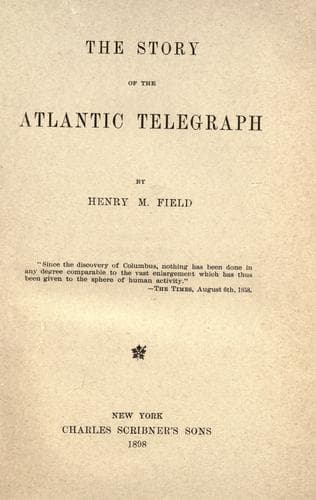
The Story of the Atlantic TelegraphField, Henry M. (Henry Martyn)
History
The Story of the Atlantic Telegraph
Field, Henry M. (Henry Martyn)
Transatlantic cables
The ship was now a dozen miles or so from the place of accident. The
cable had broken a little after noon, when the sun was shining clear, so
that Captains Anderson and Moriarty had just obtained a perfect
observation, from which they could tell, within half a mile, the very
spot where it had gone down. To reach it now, with any chance of
bringing it up, it would be necessary to hook it a few miles from the
end. It had been paid out in a line from east to west. To strike it
broadside, the ship stood off in the afternoon a few miles to the south.
Here the grapnel was thrown over about three o'clock, and struck bottom
about five, when the ship began slowly drifting back on her course. All
night long those iron fingers were raking the bottom of the deep but
grasping nothing, till toward morning the long rope quivered like a
fisherman's line when something has seized the end, and the head of the
Great Eastern began to sway from her course, as if it felt some unseen
attraction. As they began to haul in, the rapidly increasing strain soon
rendered it certain that they had got hold of _something_. But what
could it be? How did they know it was their lost cable? This question
has often been asked. They did not see it. How did they know that it was
not the skeleton of a whale, or a mast or spar, the fragment of a
wrecked ship? The question is easily answered. If it had been any loose
object which was being drawn up from the sea, its weight would have
diminished as it came nearer the surface. But on the contrary, the
strain, as shown by the dynamometer, steadily _increased_. This could
only be from some object lying prone on the bottom. To an engineer the
proof was like a mathematical demonstration. Another fact observed by
Captain Anderson was equally decisive:
"The grapnel had caught something at the exact hour when by
calculation the ship was known to be crossing the line of the
cable; nor had the grapnel upon this or any other occasion even
for an instant caught any impediment from the time of its being
lowered to the bottom, until the hour indicated by calculation,
when the cable ought to be hooked."
Having thus caught the cable, they had good hopes of getting it again,
their confidence increasing with every hundred fathoms brought on board.
For hours the work went on. They had raised it seven hundred fathoms--or
three quarters of a mile--from the bottom, when an iron swivel gave way,
and the cable once more fell back into the sea, carrying with it nearly
two miles of rope.
Public-domain text, read in full here on John Shaqi.
Reviews
Reviews
No reviews yet
Be the first to share your thoughts on this work.
Elsewhere in the archive
Join the Discussion
Join the discussion
Sign in to leave a comment or review.
Sign InorCreate an account