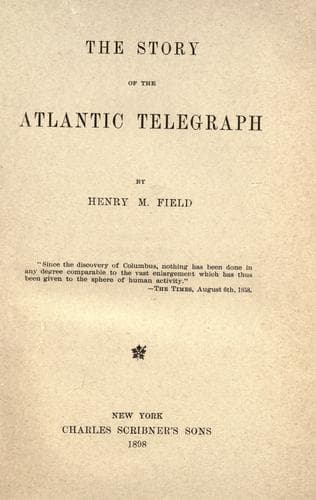
The Story of the Atlantic TelegraphField, Henry M. (Henry Martyn)
History
The Story of the Atlantic Telegraph
Field, Henry M. (Henry Martyn)
Transatlantic cables
In this offer the contractors assumed a very large risk. They now went a
step further, and in the contingency of the capital not being raised
otherwise, they offered _to take it all themselves_--to lay the line at
their own risk, and to be paid only in the stock of the Company, which,
of course, must depend for its value on the success of the next
expedition. It was finally resolved to raise six hundred thousand pounds
of new capital by the issue of a hundred and twenty thousand shares of
five pounds each, which should be preferential shares, entitled to a
dividend of twelve per cent. before the eight per cent. dividend to be
paid on the former preference shares, and the four per cent. on the
ordinary stock. This was offering a substantial inducement to the public
to take part in the enterprise, and it was thought with reason that this
fresh issue of stock, though it increased the capital of the Company,
yet as it was all to be employed in forwarding the great work, would not
only create new property, but give value to the old. The proposal of the
manufacturers was therefore at once accepted by the Directors, and the
work was instantly begun. Thus hopeful was the state of affairs when Mr.
Field returned to America in September.
But he was never easy to be long out of sight of his beloved cable, and
so three months after he went back to England, reaching London on the
twenty-fourth of December. He came at just the right moment, for the
Atlantic Telegraph was once more in extremity. Only two days before the
Attorney-General of England had given a written opinion that the Company
_had no legal right_ to issue new twelve per cent. preference shares,
and that such issue could only be authorized by an express act of
Parliament. This was a fatal decree to the Company. It was the more
unexpected, as, before offering the twelve per cent. capital, they had
been fortified by the opinions of several eminent lawyers and solicitors
in favor of the legality of their proceedings. It invalidated not only
what they were going to do, but what they had done already. Hence, as
the effect of this decision, all the works were stopped, and the money
which had been paid in was returned to the subscribers.
This was a new dilemma, out of which it was not easy to find a way of
relief. Parliament was not in session, Lords and Commons being away in
the country keeping the Christmas holidays. Even if it had been, the
time for applying to it had passed, as a notice of any private bill to
be introduced must be given before the thirtieth of November, which was
gone a month ago. To wait for an act of Parliament, therefore, would
inevitably postpone the laying of the cable for another year. So
disheartening was the prospect at the close of 1865.
But they had seen dark days before, and were not to give it up without
a new effort. Happily, the cause had strong friends to stand by it even
in this crisis of suspended animation.
Public-domain text, read in full here on John Shaqi.
Reviews
Reviews
No reviews yet
Be the first to share your thoughts on this work.
Elsewhere in the archive
Join the Discussion
Join the discussion
Sign in to leave a comment or review.
Sign InorCreate an account