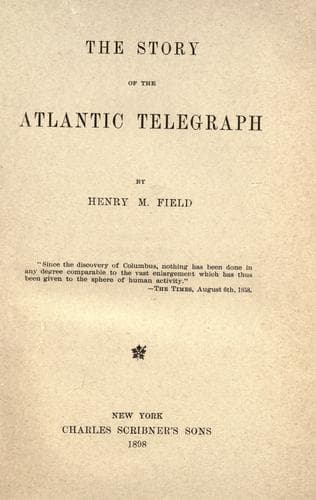
The Story of the Atlantic TelegraphField, Henry M. (Henry Martyn)
History
The Story of the Atlantic Telegraph
Field, Henry M. (Henry Martyn)
Transatlantic cables
The terms being settled, it remained only to raise the capital. The
Telegraph Construction and Maintenance Company led off with a
subscription of £100,000. This was followed by the names of ten
gentlemen, who put down £10,000 apiece. Of these Mr. Gooch declared his
willingness to increase his subscription of £10,000 to £20,000, while
Mr. Brassey would put down £60,000, if it were needed. Mr. Henry Bewley,
of Dublin also, who was already a large owner of the Atlantic stock,
declared his readiness to add £20,000 more. But this was not necessary:
and so they all stood at £10,000. The names of these ten subscribers
deserve to be given, as showing who stood forward to save the cause in
this crisis of its fate. They were: Henry Ford Barclay, Henry Bewley,
Thomas Brassey, A. H. Campbell, M.P., George Elliot, Cyrus W. Field,
Richard Atwood Glass, Daniel Gooch, M.P., John Pender, M.P., and John
Smith. There were four subscriptions of £5,000: by Thomas Bolton and
Sons, James Horsfall, A Friend of Mr. Daniel Gooch, M.P., and John and
Edwin Wright; one of £2,500 by John Wilkes and Sons; three of £2,000 by
C. M. Lampson, J. Morison, and Ebenezer Pike; and two of £1,000 by
Edward Cropper, and Joseph Robinson,--making in all £230,500.
These were all private subscriptions made before even the prospectus was
issued, or the books opened to the public. After such a manifestation of
confidence, the whole capital was secured within fourteen days. This was
a great triumph, especially at a time of general depression in
commercial affairs in England.
And now once more the work began. No time was to be lost. It was already
the first of March, and but four months remained to manufacture sixteen
hundred and sixty nautical miles of cable, and to prepare for sea. But
the obstacles once cleared away, all sprang to their work with new hope
and vigor.
In the cable to be made for the new line, there was but little change
from that of the last year, which had proved nearly perfect. Experience,
however, was constantly suggesting some improvement; and while the
general form and size were retained, a slight change in the outer
covering was found to make the cable both lighter and stronger. The iron
wires were _galvanized_, which secured them perfectly from rust or
corrosion by salt water. Thus protected, they could dispense with the
preservative mixture of the former year. This left the cable much
cleaner and whiter. Instead of its black coat, it had the fresh, bright
appearance of new rope. It had another advantage. As the tarry coating
was sticky, slight fragments of wire might adhere to it, and do injury,
a danger to which the new cable was not exposed. At the same time,
galvanizing the wires gave them greater ductility, so that in the case
of a heavy strain the cable would stretch longer without breaking. By
this alteration it was rendered more than four hundred-weight lighter
per mile, and would bear a strain of nearly half a ton more than the one
laid the year before.
Public-domain text, read in full here on John Shaqi.
Reviews
Reviews
No reviews yet
Be the first to share your thoughts on this work.
Elsewhere in the archive
Join the Discussion
Join the discussion
Sign in to leave a comment or review.
Sign InorCreate an account