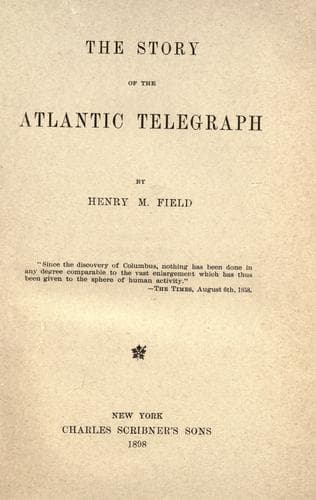
The Story of the Atlantic TelegraphField, Henry M. (Henry Martyn)
History
The Story of the Atlantic Telegraph
Field, Henry M. (Henry Martyn)
Transatlantic cables
Kerry is the temporal head, looking on benignly from his
car--the bright eyes, supple figures, and innocent faces of the
peasant lasses, and the earnestly hopeful expression of
all--made up a picture impossible to describe with justice. Add
to this, the startling abruptness with which the tremendous
cliffs stand flush out of the water, the alternations of bright
wild flowers and patches of verdure with the most desolate
barrenness, the mountain sheep indifferently cropping the
short, sweet grass, and the undercurrent of consciousness of
the mighty interests at stake, and few scenes will seem more
important and interesting than that of yesterday."
As the ships are now ready for sea, and all who are to embark have come
on board, we may look about us at the personnel of the expedition. Who
are here? We recognize many old familiar faces, that we have seen in
former campaigns--gallant men who have had many a sea-fight in this
peaceful war. First, the eye seeks the tall form of Captain Anderson.
There he is, modest and grave, of few words, but seeing every thing,
watching every thing, and ruling every thing with a quiet power. And
there is his second officer, Mr. Halpin, who keeps a sharp lookout after
the crew, to see that every man does his duty. While he thus keeps watch
of all on board, Staff Commander Moriarty, R. N., comes on deck, with
instruments in hand, to look after the heavenly bodies, and reckon the
ship's latitude and longitude. This is an old veteran in the service,
who has been in all the expeditions, and it would be quite "improper,"
even if it were possible, for a cable to be laid across the Atlantic
without his presence and aid. And here comes Mr. Canning, the engineer,
whose deep-sea soundings, the last year, were on a scale of such
magnitude, and who, if he cannot well dive deeper, means to pull
stronger the next time. That slight form yonder is Professor Thomson, of
Glasgow, a man who in his knowledge of the subtle element to be brought
into play, and the enthusiasm he brings to its study, is the very genius
of electrical science; and this is Mr. Varley, who seems to have the
lightning in his fingers, and to whom the world owes some marvellous
discoveries of the laws of electricity. Mr. Willoughby Smith, a worthy
associate in these studies and discoveries, goes out on the ship as
electrician.
Public-domain text, read in full here on John Shaqi.
Reviews
Reviews
No reviews yet
Be the first to share your thoughts on this work.
Elsewhere in the archive
Join the Discussion
Join the discussion
Sign in to leave a comment or review.
Sign InorCreate an account