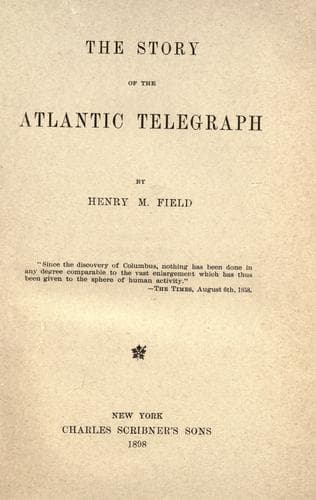
The Story of the Atlantic TelegraphField, Henry M. (Henry Martyn)
History
The Story of the Atlantic Telegraph
Field, Henry M. (Henry Martyn)
Transatlantic cables
"Friday.--Yesterday was a day of complete success, the paying
out in every respect satisfactory. The wind still from the
eastward, but inclined to draw to the northward, the sea
entirely gone down. As Mr. Canning told us we should see the
after tank emptied at eleven o'clock, ship's time, we were all
collected there about ten o'clock, by which time the cable was
down to the last flake. Next to having daylight for changing
from the after to the fore tank, we could not have had a more
favorable time--clear starlight, no wind, and a smooth sea.
Looking down into the tank, the scene was highly picturesque.
The cable-watch, whose figures were lighted up by the lamps
suspended from above, slowly and cautiously lifted the turns of
the coil to ease their path to the eye. As each found its way
to the drum, the wooden floor of the tank showed itself, and
then we saw more floor, and as its area increased the cable
swept along its surface with a low, subdued noise, until, with
a graceful curve, it mounted to the outlet, where it was soon
to join a fresh supply; and now we hear the word passed that
they have arrived at the last turn, and the men who stood on
the stages of the platform of the eye with the bight, watch the
arrival of the cable and pass it up with tender caution, until
it reaches the summit; then it rushes down a wooden incline to
meet the spliced rope, which had by this time come down along
the trough leading from the forward tank. This operation was
conducted with great skill by Mr. Canning and his experienced
assistants, Messrs. Clifford and Temple. At eleven minutes past
one A.M. (Greenwich time), the fresh rope was going over the
stern, and the screw engines going ahead at thirteen minutes
past one. A watch of four men is now stationed, fore and aft,
all along the trough, which is illuminated by many lamps at
short distances from each other. A lamp with a green light
indicates the mile-mark as it comes up from the tank, and this
signal is repeated until it reaches the stern, where it is
recorded by the clerk who keeps the cable-log, in an office
adjoining the paying-out machinery. A red lamp indicates
danger. During the daytime red and blue flags are used. All
through the night the sea was smooth as glass, and by this
morning we saw that a sensible impression had been made on the
contents of the fore tank. The ship begins to lighten at the
bows, and by this time to-morrow will come up more as the
cable passes out of the tank.
Public-domain text, read in full here on John Shaqi.
Reviews
Reviews
No reviews yet
Be the first to share your thoughts on this work.
Elsewhere in the archive
Join the Discussion
Join the discussion
Sign in to leave a comment or review.
Sign InorCreate an account