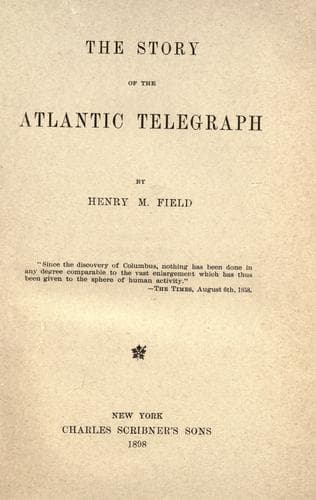
The Story of the Atlantic TelegraphField, Henry M. (Henry Martyn)
History
The Story of the Atlantic Telegraph
Field, Henry M. (Henry Martyn)
Transatlantic cables
"Saturday evening, July 14th.--General Cialdini is moving upon
Rovigo with an army of one hundred thousand men and two hundred
guns. The Austrians have evacuated the whole country between
the Mincio and Adige."
A day or two later:
"Cialdini has occupied Padua, twenty-three miles from Venice,
on the railway connecting that city with the Quadrilateral, and
the Austrians are shut up in Venice."
"Tuesday, 17th.--Prussians had successful engagement before
Olmütz yesterday; captured six guns. Further fighting expected
to-day. Austrians withdrawing from Moldavia toward
Vienna."----"Conflict between Prussians and Federals. Prussians
completely victorious. Federals evacuating Frankfort, and
Prussians marching there."
"Thursday, 19th.--Prussians repeating victories, and gaining
adhesions from small States. The main army within fifty miles
of Vienna--have cut the railway to Vienna. Austrian army
between Prussians and Vienna, under Archduke, one hundred and
sixty thousand men. Money and archives removed from Vienna to
Comorn."
"20th.--Frankfort occupied by the Prussians, who are marching
on Vienna. Yesterday, Italian fleet, consisting of iron-clad
vessels and several steamers, opened attack on Island of Lissa
on the coast of Dalmatia--result not known."
The next day it is reported thus:
"Severe naval engagement off Lissa. Austrians claim the
victory. Sunk one Italian iron-clad, run down another, blew up
a third."
"July 21st.--Prussians crossed river; march near Holitzon,
Hungary. Austria accepted proposal of armistice. Prussia will
abstain from hostilities for five days, during which Austria
will have to notify acceptance of preliminaries. A long letter
published from the King of Prussia to the Queen, giving account
of battle of Königgrätz."
The interest excited by such news may be imagined, coming while the
events were yet fresh. Twice a day was the bulletin set up on the deck,
and was surrounded by an eager crowd reading what had transpired on the
Continent but a few hours before. Nor was the intelligence confined to
the Great Eastern. By an arrangement of signals, more complete than ever
was used in a squadron before, the news was telegraphed to the convoy.
All the ships had been furnished with experienced signal-men by the
Admiralty. The system adopted was that known as Colomb's Flash Signals,
by which, even in the darkest night, messages could easily be flashed to
a distance of several miles. Thus all the ships were supplied with news
twice a day, and the great military events in Europe were discussed in
every cabin as eagerly as in the clubs of London. Again Deane's Diary
reports:
Public-domain text, read in full here on John Shaqi.
Reviews
Reviews
No reviews yet
Be the first to share your thoughts on this work.
Elsewhere in the archive
Join the Discussion
Join the discussion
Sign in to leave a comment or review.
Sign InorCreate an account