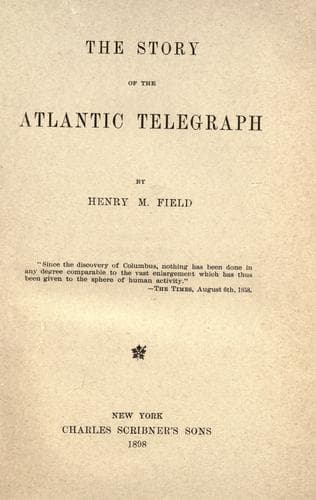
The Story of the Atlantic TelegraphField, Henry M. (Henry Martyn)
History
The Story of the Atlantic Telegraph
Field, Henry M. (Henry Martyn)
Transatlantic cables
Her Majesty were advised to offer a citizen of the United
States, for a service rendered alike to both countries, British
marks of honor, which, following the example of another highly
distinguished citizen, he might feel himself unable to accept."
The reason assigned by Lord Derby for the omission of Mr. Field's name
in the distribution of honors, was perfectly understood and entirely
satisfactory. The British Government had once before offered a baronetcy
to Mr. George Peabody in recognition of his princely benefactions to the
poor of London, but while he appreciated the honor, he felt that as a
citizen of the United States, he could not accept it, and the same
reason would apply in the present case. But while this alone prevented
official recognition, it could not prevent the hearty expression of
Englishmen who knew the history of the great enterprise from the
beginning. At this very dinner, the Chairman gave, as the first toast,
"The Original Projectors of the Atlantic Cable," which he proposed early
in order to give Mr. Cyrus Field (who was very near to them, although he
happened to be in America!) a chance of responding! The allusion is
explained by the remark of one present who had said:--
"You will be pleased to hear that Mr. Bright has kindly brought
the telegraph wire into the room in which we are sitting, and
no sooner will the toast involving the mention of Mr. Field's
name be given from the chair, than it will be flashed with
lightning speed to Valentia, thence to Newfoundland, and if Mr.
Field is at home, it is quite possible that he himself will
receive it, ere the echo of your ringing cheers has died away
in Liverpool."
A message was at once sent from the room to Newfoundland, and a reply
received back that Mr. Field had left for New York. In continuing his
speech, Sir Stafford Northcote said: "I think there can be no doubt in
the minds of those who have carefully examined the history of these
transactions, that it is to Mr. Cyrus Field that we owe the practical
carrying out of the idea which has borne such glorious fruit. I am sure
there is none to whom we owe more, or whose name stands in prouder
connection with this great undertaking, than the name of Mr. Cyrus
Field."
He called upon Sir Charles Bright to reply, who detailed somewhat the
history of the enterprise from the very beginning in 1856, when "Mr.
Cyrus Field, to whom the world was more indebted than to any other
person for the establishment of the line, came to England upon the
completion of the telegraph between Nova Scotia and Newfoundland."
To the same effect is the testimony of a distinguished writer, W. H.
Russell, LL.D., who was on board of the Great Eastern in 1865, as the
correspondent of The Times, and wrote a very graphic History of the
Expedition (p. 10):
Public-domain text, read in full here on John Shaqi.
Reviews
Reviews
No reviews yet
Be the first to share your thoughts on this work.
Elsewhere in the archive
Join the Discussion
Join the discussion
Sign in to leave a comment or review.
Sign InorCreate an account