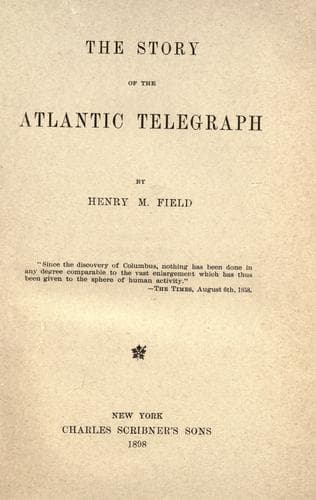
The Story of the Atlantic TelegraphField, Henry M. (Henry Martyn)
History
The Story of the Atlantic Telegraph
Field, Henry M. (Henry Martyn)
Transatlantic cables
To testify the public appreciation of this great achievement, and of his
part in it, the Chamber of Commerce of New York invited Mr. Field to a
public banquet, which was given on the fifteenth of November. It was
attended by about three hundred gentlemen--not only merchants and
bankers, but men of all professions--lawyers and judges, clergymen and
presidents of colleges, members of the Government and foreign ministers,
and officers of the army and navy. The President of the Chamber of
Commerce, Mr. A. A. Low, presided, and, at the close of his opening
speech, said:
"We may fairly claim that, from first to last, Cyrus W. Field
has been more closely identified with the Atlantic Telegraph
than any other living man; and his name and his fame, which the
Queen of Great Britain has justly left to the care of the
American government and people, will be proudly cherished and
gratefully honored. We are in daily use of the fruits of his
labors; and it is meet that the men of commerce, of literature
and of law, of science and art--of all the professions that
impart dignity and worth to our nature--should come together
and give a hearty, joyous, and generous welcome to this truly
chivalrous son of America."
He proposed the health of their guest:
"Cyrus W. Field, the projector and mainspring of the Atlantic
Telegraph: while the British government justly honors those who
have taken part with him in this great work of the age, _his_
fame belongs to us, and will be cherished and guarded by his
countrymen."
In his reply, Mr. Field told the story with the utmost simplicity,
passing rapidly over the nearly thirteen years, through which the
enterprise had struggled with such doubtful fortunes, and taking pains
to do full justice to all who shared in its labors, its disappointments
and its triumphs. Especially did he award the highest praise to the
government of England for its liberal and constant support; to her men
of science and her great capitalists, and to the officers of ships,
electricians and engineers, who had taken part in this undertaking. In
closing, he said:
Public-domain text, read in full here on John Shaqi.
Reviews
Reviews
No reviews yet
Be the first to share your thoughts on this work.
Elsewhere in the archive
Join the Discussion
Join the discussion
Sign in to leave a comment or review.
Sign InorCreate an account