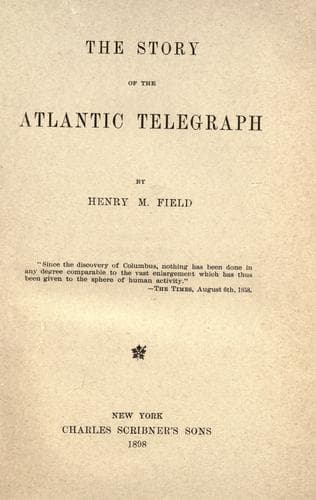
The Story of the Atlantic TelegraphField, Henry M. (Henry Martyn)
History
The Story of the Atlantic Telegraph
Field, Henry M. (Henry Martyn)
Transatlantic cables
"I am very sorry that I cannot leave Washington this week, and
so cannot avail myself of your kind invitation to join you in
congratulations to Mr. Field upon the success of his grand
undertaking. It is the most wonderful achievement of
civilization; and to his sagacity, patience, perseverance,
courage, and faith, is civilization indebted for it.
"Such works entitle their authors to distinguished rank among
public benefactors. You will write the name of your honored
guest high upon that illustrious roll, and there it will remain
in honor, while oceans divide and telegraphs unite mankind."
There was a telegraph instrument in the room, and despatches were
received during the evening from Mr. Seward, Secretary of State, and
other members of the Cabinet at Washington, from Lord Monck,
Governor-General of Canada, from the Governor of Newfoundland, and
others. One, from Captain Sir James Anderson, was dated at London the
same day. John Bright also wrote a despatch and sent it to London, but
by an oversight it was not forwarded. He afterward wrote a letter,
giving the message. It was as follows:
"It is fitting you should honor the man to whom the whole world
is debtor. He brought capital and science together to do his
bidding, and Europe and America are forever united. I cannot
sit at your table, but I can join in doing honor to Cyrus W.
Field. My hearty thanks to him may mingle with yours."
He adds that he regarded what had been done as the most marvellous thing
in human history; as more marvellous than the invention of the art of
printing, or, he was almost ready to say, than the voyages of the
Genoese; and of Mr. Field, he says, "The world does not yet know what it
owes to him, and this generation will never know it."
About the same time, in a speech at a great Reform Meeting in Leeds, he
bore this proud testimony:
"A friend of mine, Cyrus Field, of New York, is the Columbus of
our time, for after no less than forty voyages across the
Atlantic, in pursuit of the great aim of his life, he has at
length, by his cable, moored the New World close alongside the
Old."
Nor was this mere rhetoric, a burst of extravagance, to which an orator
might give way in the excitement of a public occasion; it was a
comparison which he repeated on many occasions, though slightly varied
in expression. Mr. G. W. Smalley, the well-known correspondent of the
New York Tribune, in writing from London, on the very day that Mr. Field
was carried to his grave, recalls how he heard it from Mr. Bright's own
lips. He says:
Public-domain text, read in full here on John Shaqi.
Reviews
Reviews
No reviews yet
Be the first to share your thoughts on this work.
Elsewhere in the archive
Join the Discussion
Join the discussion
Sign in to leave a comment or review.
Sign InorCreate an account