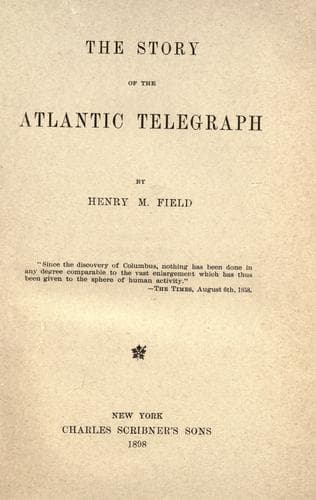
The Story of the Atlantic TelegraphField, Henry M. (Henry Martyn)
History
The Story of the Atlantic Telegraph
Field, Henry M. (Henry Martyn)
Transatlantic cables
This action of Congress reached Mr. Field in England. As he was about
returning to America, Lord Derby, still at the head of the government,
addressed to him a letter in which he repeated what he had said before
"in the Queen's name," "how much of the success of the great undertaking
of laying the Atlantic Cable was due to the energy and perseverance with
which, from the very first, in spite of all discouragements, you adhered
to and supported the project;" and adding, "Your signal services in
carrying out this great undertaking have been already fully recognized
by Congress; and it would have been very satisfactory to the Queen to
have included your name among those on whom, in commemoration of this
great event, her Majesty was pleased to bestow British honors, if it had
not been felt that, as a citizen of the United States, it would hardly
have been competent to you to accept them. As long, however, as the
telegraphic communication between the two Continents lasts, your name
cannot fail to be honorably associated with it."
This surely was all that could be expected from the government, but some
there were in England who felt that there was still a debt of honor to
be paid, which required some public testimonial. Accordingly, on Mr.
Field's return to London, in 1868, they prepared for him an imposing
demonstration in the form of a banquet, given at Willis's Rooms, on the
first of July, at which was assembled one of the most distinguished
companies that ever met to do honor to a private citizen of any country.
It embraced over four hundred gentlemen of all ranks: ministers of
state, members of parliament, both Lords and Commons; officers of the
army and navy; great capitalists--merchants and bankers; men of science
and of letters; inventors, electricians, and engineers--men eminent in
every walk of life. The Duke of Argyll presided, and speeches were made
by three members of the government--Sir John Pakington, Secretary of
State for War; Sir Stafford Northcote, Secretary of State for India; and
Sir Alexander Milne, First Sea Lord of the Admiralty; by John Bright; by
the venerable Lord Stratford de Redcliffe, so long the British Minister
at Constantinople; and by M. de Lesseps, the projector of the Suez
Canal, who had come from Egypt expressly to be present. It was a tribute
such as is rarely paid to any man while living--such tributes being
reserved for the dead--and is still more honorable in this case, alike
to the givers and the receiver, in that it was paid by the people of one
country to a citizen of another, who was regarded in both as their
common benefactor.
Public-domain text, read in full here on John Shaqi.
Reviews
Reviews
No reviews yet
Be the first to share your thoughts on this work.
Elsewhere in the archive
Join the Discussion
Join the discussion
Sign in to leave a comment or review.
Sign InorCreate an account