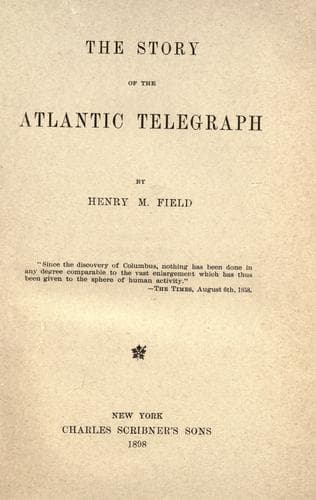
The Story of the Atlantic TelegraphField, Henry M. (Henry Martyn)
History
The Story of the Atlantic Telegraph
Field, Henry M. (Henry Martyn)
Transatlantic cables
When they returned to America, General Garfield was President of the
United States, who, though a Western man by birth, had been educated in
New England, at Williams College in Massachusetts, where he had been
graduated twenty-five years before, and which he had a desire to
revisit; and it was arranged that he should leave Washington in the
morning of July 2d, with as many of his cabinet as could be spared from
the seat of government, and come on to New York and all be entertained
at "Ardsley," and the next day proceed up the Hudson and across the
country to Williamstown; a programme which was interrupted by the
terrible news that on arriving at the station in Washington he had been
shot, an event that instantly recalled the assassination of Lincoln. At
once there rose a cry of horror from one end of the land to the other,
and for weeks the whole country was watching by the bedside of the
illustrious sufferer.
Of course, the sympathy for the wife and children was universal, but Mr.
Field was the first to give this sympathy a practical direction. With
his quick eye he saw the condition in which they would be left by the
death of the President, as for them the law makes no provision. His
salary stops at the very day and hour that he ceases to live, nor is
there a pension settled upon his family, nor can anything be paid from
the national treasury except by special act of Congress. In this
extremity it occurred to Mr. Field that what the Government failed to do
should be made up by private generosity; and even before General
Garfield's death he started a subscription, heading it with five
thousand dollars, and taking it in person to his rich friends. The self
imposed task occupied him several months, in which he raised a fund of
over three hundred and sixty thousand dollars, which was put into United
States four per cent. bonds, yielding an interest of over twelve
thousand dollars a year, to be paid quarterly during the life of Mrs.
Garfield, and then to go to her children. It was a great satisfaction to
have thus provided for those who bore the name of a President of the
United States, so that they should be able to live in the comfort and
dignity that befitted the family of one who had occupied the most
exalted station in the government.
Not content with this, Mr. Field went to Washington, and urged upon his
friends in Congress, and finally succeeded in getting passed, a bill
giving to the widows of all Presidents a pension of $5,000, which, it
added to his gratification to know, would apply to the venerable Mrs.
Polk: and that still goes, and will go during her lifetime, to the wife
of General Grant, as the slight expression of a nation's gratitude.
Public-domain text, read in full here on John Shaqi.
Reviews
Reviews
No reviews yet
Be the first to share your thoughts on this work.
Elsewhere in the archive
Join the Discussion
Join the discussion
Sign in to leave a comment or review.
Sign InorCreate an account