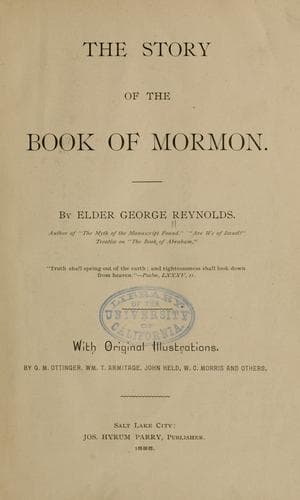
Book of Mormon; Latter Day Saint churches -- Doctrines; Latter Day Saints
Helaman himself was a righteous man: He did observe to keep the
judgments, and the statutes, and the commandments of God; and he did do
that which was right in the sight of God continually, and he did walk
after ways of his father, insomuch that he did prosper in the land. So
writes the historian of Helaman; what more can be said of any man?
Helaman had two sons to whom he gave the names of Nephi and Lehi, to
remind them, when they heard their own names called, of the faith and
goodness of their great ancestors, who, by God's direction, led their
fathers to the promised land. When Helaman died he was succeeded by his
son Nephi.
CHAPTER XXXVII.
THE SONS OF HELAMAN--NEPHI's RIGHTEOUS RULE--THE LAMANITES AGAIN
INVADE ZARAHEMLA--THEY DRIVE THE NEPHITES INTO THE NORTHERN
CONTINENT--THE MINISTRATIONS OF NEPHI AND LEHI--THE MANIFESTATIONS
OF GOD'S POWER IN THE CITY OF NEPHI--AMINADAB--THE CONVERSION OF THE
LAMANITES--UNIVERSAL PEACE.
(HELAMAN CHAP. 4 AND 5.)
In Nephi we have one of the greatest prophets that ever trod the earth,
or to whom the God of our salvation revealed his glorious will. He
lived during the greater portion of the first century before Christ,
and disappeared from the knowledge of mankind but a short time before
the advent of the Messiah as a babe in Bethlehem. He is first referred
to in the Book of Mormon (B. C. 44) as the elder of Helaman's two
sons, Lehi being the younger. These two brothers appear to have been
inseparable during their lives. They are nearly always mentioned as
associated in the great and oft-times perilous labors of the ministry
undertaken for the salvation of either Nephites or Lamanites. We have
no information with regard to the time of Nephi's birth, but when his
father died, in the year B. C. 39, he succeeded him as chief judge, the
duties of which office he filled with wisdom and justice for about nine
years, when owing to the wickedness of the people, he resigned that
office, and Cezoram was chosen by the people in his stead (B. C. 30).
Public-domain text, read in full here on John Shaqi.
Reviews
Reviews
No reviews yet
Be the first to share your thoughts on this work.
Elsewhere in the archive
Join the Discussion
Join the discussion
Sign in to leave a comment or review.
Sign InorCreate an account